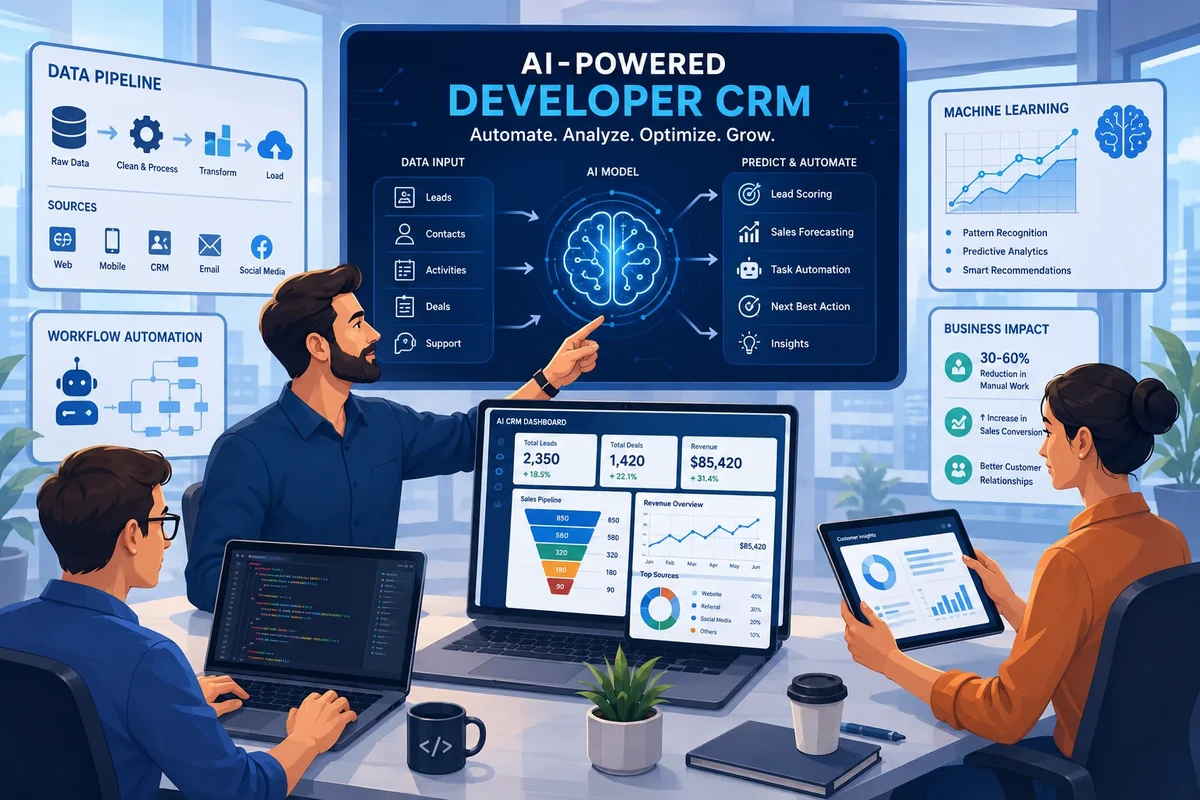
By 2026, AI-powered CRM is no longer a passive record-keeping system or a superficial writing assistant; it operates as an autonomous multi-agent orchestration layer that uncovers hidden buyer paths, triggers cross-platform workflows, and executes administrative tasks without human manual intervention. Burley Kawasaki, Global VP of Product Marketing and Strategy at Creatio, pointed out that agentic automation is not simply another technology trend, but “the foundation of how enterprises will innovate, compete, and grow in the AI Economy.” For revenue operations leaders, Chief Commercial Officers, and CRM systems architects, staying competitive requires shifting from reactive software interfaces to autonomous agent fabrics that dynamically evaluate buyer signals, reconcile cross-departmental records, and guide pipeline execution.
Beyond Data Logging: The Autonomous Shift in 2026 CRM
In 2026, AI-powered CRM shifts from passive data logging to autonomous execution. Rather than requiring sales reps to manually enter records, autonomous multi-agent systems detect buyer signals, update pipeline stages, schedule follow-ups, and trigger cross-platform actions without manual clicks, driving up to 45% higher conversion rates.
Legacy CRM configurations functioned as digital filing cabinets that placed the operational burden on commercial teams. Account executives spent substantial portions of their working hours manually updating lead stages, logging meeting notes, and copy-pasting customer details across platforms. Autonomous CRM architectures invert this dynamic by converting the system of record into an active execution engine. When prospective buyers display high-intent behaviors across public market alerts, social channels, or product usage touchpoints, autonomous agents capture the telemetry, construct account timelines, and initiate context-aware outreach sequences.
As the Rings AI Blog observed regarding this structural change: “In 2026, CRM success no longer depends on how much data you input or even how big your network; it depends on what your system can do with that data and how it can uncover hidden paths to prospects before your competitors do.” Rather than relying on raw contact volume, relationship-driven platforms evaluate network interactions and uncover non-obvious warm introduction pathways for enterprise sales teams, venture capital firms, and fast-scaling startups.
The operational return on this autonomous transition is substantial. Sales teams utilizing AI sales automation achieve a 35% reduction in manual data entry tasks alongside a 45% increase in lead conversion rates. Eliminating manual logging frees commercial teams to dedicate their time to high-value strategic negotiations. On a macroeconomic scale, market analysts at Qodexaa project the global AI in CRM market will expand to $50 billion by 2028, growing at a 28% compound annual growth rate within a broader enterprise CRM sector projected to reach $128 billion.
Why Single-Application AI Assistants Fall Short
Enterprise customer journeys rarely take place inside a single software interface. Customer touchpoints span product telemetry, billing gateways, support ticketing systems, enterprise resource planning databases, and email servers. When organizations deploy AI assistants that are strictly embedded within a single customer relationship management tool, they encounter severe architectural boundaries.
Application-embedded tools optimize tasks within their own database boundaries, but they cannot orchestrate workflows across the wider corporate ecosystem. Industry analysts observed that AI embedded solely inside a single application—such as Salesforce Einstein for CRM—operates strictly within the borders of that isolated system. Because these single-app tools lack cross-platform agency, human workers must continue serving as operational conduits, manually copying customer context from CRM records into ERP, accounting, or fulfillment systems.
Architectural Warning: Relying on isolated, single-application AI tools creates operational blind spots. When an embedded assistant lacks direct data access to billing, service, and inventory systems, its predictive lead scores and outreach recommendations degrade due to incomplete customer context.
Industry research from A2Z Cloud confirms that CRM intelligence depends on data access and system architecture rather than feature checklists. Enterprise tech stacks typically distribute customer touchpoints across 8 to 15 fragmented applications. Fragmented stacks isolate critical context: sales reps cannot see that an expanding account has three unresolved high-priority support tickets, while customer success agents cannot view imminent renewal contract discussions.
Evaluating enterprise CRM architectures requires examining operational boundaries, governance demands, and coordination overhead. The table below analyzes the structural trade-offs between embedded assistants, unified platform suites, and multi-agent orchestration fabrics.
Architecture Model |
Operational Scope |
Human Overhead |
Cross-Platform Interoperability |
|---|---|---|---|
Single-Application Embedded AI (e.g., Standalone Salesforce Einstein) |
Confined to proprietary CRM database boundaries and internal objects. |
High; human operators must manually transfer data to ERP, billing, and support tools. |
Low; requires custom point-to-point API development and brittle middleware pipelines. |
Unified Operational Platform Substrates (e.g., Zoho Zia Ecosystem) |
Spans native ecosystem applications (CRM, Books, Desk, Campaigns). |
Moderate; automation rules execute cross-functional workflows within the platform suite. |
Moderate to High; deep internal synchronization, but requires connectors for external third-party tools. |
Autonomous Multi-Agent Orchestration Fabrics (e.g., Creatio Composable Architecture, Workato Genies) |
Enterprise-wide orchestration across heterogeneous, multi-vendor applications. |
Low; autonomous agent swarms negotiate, update, and resolve tasks across platforms. |
High; leverages standardized communication layers such as the Model Context Protocol (MCP). |
As demonstrated across these architectural categories, cross-platform multi-agent fabrics remove the operational friction of manual data handoffs. Moving intelligence from isolated point features to an orchestration layer ensures that every customer touchpoint updates the collective enterprise state in real time.
Core Technical Pillars of Multi-Agent CRM Systems
Multi-agent CRM architectures operate on three core technical pillars: event-driven agent execution across enterprise apps, Model Context Protocol (MCP) integrations connecting external models to internal workflows, and versioned long-term memory governance to prevent operational drift, allowing autonomous swarms to collaborate across sales, marketing, and support.
Forrester predicts a macro shift across enterprise software from role-based, single-purpose AI toward collaborative multi-agent systems. In a legacy setup, a standalone generative model might write an email draft while an isolated regression model scores pipeline risk. In a multi-agent framework, specialized software agents function as an interconnected network. A prospecting agent discovers an executive job change, a qualification agent verifies organizational budget through historical procurement data, and a scheduling agent negotiates calendar availability across time zones without human intervention.
Event-Driven Workflows and MCP Connectivity
Autonomous collaboration requires open, standardized connectivity protocols. Multi-agent systems utilize the Model Context Protocol (MCP) to provide large language models and autonomous agents with secure, controlled access to enterprise tools and data sources. Rather than writing fragile custom API endpoints for every system update, MCP provides a uniform interface for reading context, inspecting schemas, and calling verified external functions.
Workato Genies exemplifies this model by orchestrating autonomous multi-agent workflows across disparate corporate environments. When an event fires—such as a customer signing an order form or a user hitting a specific product usage milestone—orchestration agents trigger downstream financial invoicing, provisioning, and territory re-assignment. To safeguard enterprise operations, RevOps architects deploy deterministic circuit breakers and API firewalls within this communication layer. These guardrails enforce hard approval limits: if an autonomous outreach agent attempts to modify standard discount terms beyond preset guidelines or alter indemnity clauses, the system immediately trips a circuit breaker and initiates a human-in-the-loop escalation.
Long-Term Memory and Drift Containment
Autonomous agents cannot rely solely on short-term conversational context windows. Multi-agent CRM systems depend on structured long-term memory architectures that blend vector retrieval, historical graph databases, and transactional relational stores. Without disciplined memory governance, agent networks suffer from operational drift, hallucinating outdated account details or applying obsolete pricing books.
Maintaining memory integrity requires systematic data hygiene and schema pruning:
- Dirty Data Detoxification: Engineering teams must clean legacy databases by deprecating zombie custom fields, merging duplicate records, and reconciling conflicting omnichannel touchpoints before indexing customer profiles into vector embeddings.
- Access Control and Data Partitioning: Role-based access controls apply to agent memory systems, preventing an automated customer support agent from exposing confidential contract terms stored in enterprise deal rooms.
- Edge Processing via Small Language Models: Field commercial representatives frequently operate in low-connectivity environments. Local small language models (SLMs) running on mobile hardware transcribe sales meetings, extract structured customer action items, and sanitize private data on-device before syncing back to the central corporate cloud.
Measurable Revenue and Productivity Gains Across the Enterprise
Adopting autonomous CRM architectures delivers verifiable operational and financial performance gains across commercial enterprises. Management consulting research from McKinsey & Company demonstrates that proactively delivering targeted interactions through AI generates a 5% to 8% revenue increase while lifting customer satisfaction scores by 15% to 20%. McKinsey also reports that 90% of enterprises now utilize AI technology within at least one business operational function, marking a transition from experimental pilot projects to baseline operational infrastructure.
Empirical evidence across enterprise sales and customer service operations highlights significant performance improvements:
- Forecasting Accuracy: Machine learning algorithms that evaluate historical CRM trends alongside real-time pipeline telemetry improve sales forecasting accuracy by up to 70%, giving finance leaders reliable visibility into quarterly performance.
- Commercial Conversion: Organizations deploying integrated AI CRM solutions report an average 29% sales increase, driven by algorithmic lead prioritization and automated prospect follow-up.
- Support Efficiency: Companies deploying generative AI CRM integrations report average service quality improvements of 34%, with administrative operational costs dropping by up to 90% for automated tasks.
- Handle Time Reduction: French telecommunications provider Bouygues Telecom deployed generative AI capabilities that summarize support calls and log customer interactions into CRM records in real time, reducing customer support handle time by 30%.
By automating call synthesis and post-interaction record management, service teams transition from reactive troubleshooting to proactive account health management, resolving customer issues before they lead to contract churn.
A Three-Phase Enterprise Implementation Roadmap
Transitioning from an assistive copilot configuration to an autonomous multi-agent CRM ecosystem requires an implementation strategy focused on data readiness, governed automation, and cross-platform orchestration. In 2026, enterprise software investments are evaluated on concrete productivity metrics—hours recovered, cost reduction, and business output—rather than novelty.
- Phase 1: Operational Substrate Audit and Schema Consolidation (Weeks 1 to 4): Organizations must map their fragmented application stack, which typically encompasses 8 to 15 separate systems. RevOps engineers identify data silos, purge duplicate records, reconcile conflicting custom schema, and establish unified pipelines. Platforms such as Creatio utilize no-code composable application architectures and marketplace integrations to assemble unified data models without requiring extensive bespoke software development.
- Phase 2: Workflow Automation and Predictive SLA Deployment (Weeks 5 to 10): Teams introduce automated pipeline routing, predictive churn models, and event triggers. Natural language workflow builders allow operations managers to define operational intent directly. Within the Zoho ecosystem, the Zia engine operationalizes natural language directives like:
“When a high-value lead downloads our pricing guide, notify the sales director and create a task for follow-up within 2 hours.”
Zia then optimizes execution through contextual recommendations, noting that:
“Leads from this industry typically convert faster when contacted within 30 minutes rather than 2 hours.”
This operational feedback loop improves lead velocity without overwhelming commercial teams.
- Phase 3: Multi-Agent Orchestration and Governance Safeguards (Weeks 11 and Beyond): The enterprise deploys autonomous multi-agent fabrics that execute cross-system workflows across sales, billing, and customer service. Systems architects implement Model Context Protocol boundaries, deterministic circuit breakers, and human-in-the-loop escalation rules. This phase also establishes tokenomic cost monitoring, tracking consumption-based inference fees, vector storage expenses, and agent execution volume to maintain a predictable total cost of ownership.
FAQ
How does CRM pricing shift from per-seat licensing to agentic models by 2026?
Enterprise CRM pricing is moving from static per-seat subscriptions to hybrid consumption models based on automated workflow execution, outcome-driven metrics, and token-based infrastructure usage. Organizations evaluate total cost of ownership across model inference, vector database storage, and agent execution volume rather than simply counting human software logins.
How do multi-agent CRM systems prevent unauthorized customer commitments?
Modern agentic architectures deploy deterministic circuit breakers, strict Model Context Protocol (MCP) permission boundaries, and real-time observability dashboards. These safeguards require human-in-the-loop escalation whenever an interaction approaches deal size thresholds, contractual ambiguity, or non-standard pricing, preventing autonomous outreach agents from making unapproved commitments.
What data readiness steps must precede autonomous CRM agent deployment?
Enterprises must audit their fragmented application stacks, eliminate conflicting custom fields across legacy databases, and purge redundant schema. Establishing unified data pipelines and structuring historical customer interactions ensures that retrieval-augmented generation pipelines feed accurate, synchronized context to autonomous agents without triggering hallucination or data drift.
How do post-2025 AI regulations affect predictive CRM lead scoring?
Regulatory frameworks such as the EU AI Act and UK GDPR classify automated customer profiling and dynamic deal qualification under high-risk transparency rules. Enterprises must maintain verifiable audit trails, conduct bias monitoring, and ensure algorithmic decisions can be explained to prevent compliance liabilities in automated sales operations.
By how much can AI improve sales forecasting accuracy?
Sales forecasting accuracy improves up to 70% when AI analyzes historical CRM data alongside real-time pipeline activity. Machine learning models identify subtle deal progression signals and historical close patterns, allowing revenue leaders to produce far more dependable revenue projections than traditional rep-reported estimates.