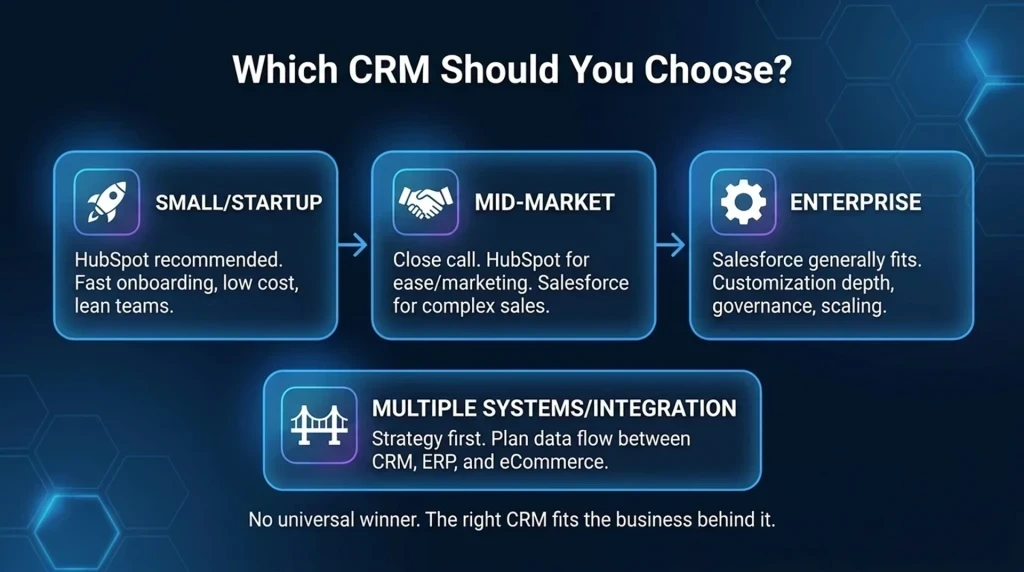
For enterprise buyers in 2026, there is no universal best CRM: Microsoft Dynamics 365 leads for organizations built on Microsoft 365 and Azure seeking cost efficiency; Salesforce remains the benchmark for complex multi-cloud deployments requiring deep custom development; and HubSpot delivers the fastest deployment velocity and highest user adoption for mid-to-large sales teams.
According to the Gartner 2026 Magic Quadrant for CRM Sales Platforms authored by Adnan Zijadic, Guy Wood, and Wendy Butler-Mafuz, Salesforce and Microsoft Dynamics 365 remain the sole two vendors placed in the Leaders quadrant. IDC worldwide CRM market share figures published in April 2026 revealed that Salesforce closed 2025 retaining 20.0% worldwide CRM market share, while Oracle captured 4.1% and Microsoft held 4.0%. For IT directors, Chief Information Officers, and revenue operations leaders evaluating 50-seat deployments, baseline capabilities such as opportunity pipelines, lead routing, and reporting have matured across the industry. Platform selection now hinges on operating model compatibility, auxiliary cloud infrastructure expenses, and adoption feasibility.
Quick verdict on enterprise CRM winners by use case
The best enterprise CRM in 2026 depends on IT architecture and customization needs: Microsoft Dynamics 365 wins for organizations invested in Microsoft 365 and ERP systems; Salesforce Sales Cloud wins for complex global organizations requiring deep bespoke workflows and agentic AI; and HubSpot Enterprise leads for rapid deployment and high seller adoption.
Software evaluation at enterprise scale must move past standardized feature check-boxes. When platforms provide equivalent baseline record management, the decision is dictated by existing technical architecture and organizational structure. Independent analysis published by Zarasa underscores this evaluation dynamic:
“Salesforce and Microsoft Dynamics 365 are the only two platforms Gartner placed in the Leaders quadrant of its 2026 CRM sales report. Both handle the fundamentals well: accounts, contacts, opportunities, forecasting, automation. The real difference is not the feature list. It is where each one came from, how it is licensed, and what happens as the company grows.” — Zarasa
Salesforce Sales Cloud serves enterprises that operate decentralized business units, demand heavy custom Apex code, require multi-cloud orchestration, and plan to deploy autonomous agentic workflows across disparate data stores. Microsoft Dynamics 365 Sales fits enterprises standardized on Microsoft enterprise agreements, Azure cloud infrastructure, and ERP backends like SAP or Microsoft Dynamics ERP, where direct integration with Entra ID, Outlook, and Teams reduces overhead. HubSpot Smart CRM targets fast-moving commercial teams and mid-market divisions where administrative agility, minimal technical debt, and immediate field adoption outweigh deep programmatic customization.
True total cost of ownership beyond seat licenses
Enterprise CRM licensing represents only a fraction of total cost of ownership. While baseline seat licenses range from $105 to $175 per user monthly, realistic annual TCO for a 50-person sales team spans $24,000 on Zoho, $46,800 to $80,000 on Dynamics 365, and $120,000 to $200,000 on Salesforce after factoring in admin, consulting, storage, and sandboxes.
Advisory consultancy Huble frames the economic reality facing enterprise IT leadership:
“Enterprise CRM selection is a business-architecture decision, not a software purchase: total cost of ownership, integration and governance outweigh feature lists.” — Huble
Comparing 50-seat annual deployment costs
Advertised software list pricing creates a false sense of budgetary predictability. On paper, Salesforce Sales Cloud Enterprise lists between $165 and $175 per user monthly, Microsoft Dynamics 365 Sales Enterprise lists at $105 per user monthly, and HubSpot Sales Hub Enterprise lists at $150 per seat monthly with mandatory onboarding packages. Cargas reports that entry subscription expenses for smaller deployments commonly span $5,000 to $35,000 annually. However, scaling to a standard 50-person revenue team reveals significant divergence in operational overhead.
A realistic 50-person Salesforce Enterprise deployment demands an actual commitment of $120,000 to $200,000 annually. This range accounts for standard user licenses alongside the necessity of dedicated certified Salesforce administrators or ongoing systems integrator retainers. Microsoft Dynamics 365 Sales costs between $46,800 and $80,000 annually for the same 50 seats when supported by an external Microsoft partner. HubSpot Professional deployments for 50 users total $54,000 to $72,000 annually due to lower administrative requirements, while Zoho CRM requires minimal technical maintenance, delivering a full 50-seat operational cost between $24,000 and $36,000 per year.
The comparative matrix below details published seat fees against real-world 50-person annual operating commitments, auxiliary storage charges, and architectural advantages across four major platform tiers.
Platform |
Entry License (User/Mo) |
Realistic 50-User Annual TCO |
Auxiliary Storage Overages |
Core Advantage |
|---|---|---|---|---|
Salesforce Sales Cloud |
$165–$175 |
$120,000–$200,000 |
$125/month per 500 MB |
Deep custom development, global multi-cloud scale, extensible data models |
Microsoft Dynamics 365 Sales |
$105 |
$46,800–$80,000 |
$40/month per GB |
Native Microsoft 365 productivity, Entra ID, and direct ERP connectivity |
HubSpot Sales Hub Enterprise |
$150 |
$54,000–$72,000 |
Tiered marketing and contact overages |
Fast implementation velocity, intuitive seller adoption, low administrative overhead |
Zoho CRM |
$20–$50 (Standard tiers) |
$24,000–$36,000 |
Add-on storage and portal fees |
Budget predictability, broad native application suite for lean teams |
Long-term operational planning requires accounting for administrative headcount and developer allocations, which consistently outpace baseline software licensing over a multi-year investment horizon.
The hidden tax of database storage and sandboxes
Auxiliary infrastructure fees frequently trigger post-deployment budget disputes when data consumption climbs. Analysis from certified partner Sunrise Technologies reveals that Microsoft Dynamics 365 Customer Engagement charges approximately $40 per month per gigabyte for additional database capacity. Salesforce charges $125 per month for 500 megabytes of database storage. For enterprises syncing continuous ERP sales order history, customer telemetry, or detailed audit trails, auxiliary data overages can compound into thousands of dollars in monthly unbudgeted expenses.
Environment segregation introduces another major expenditure. Sunrise Technologies notes that Salesforce prices full-copy development sandboxes at 30% of total annual software spend. Establishing a staging environment containing production data schemas therefore adds a substantial recurring cost to an enterprise licensing agreement. Development sandboxes, continuous deployment pipelines, and sandbox data seeding must be budgeted during initial negotiations rather than addressed as downstream technical requirements.
Cost Warning: Ingesting historical transactions, system logs, or eCommerce telemetry into primary CRM databases inflates operating costs rapidly. With Salesforce database storage priced at $125 per 500 MB monthly and full-copy sandboxes commanding 30% of contract spend, organizations must establish data archiving schedules and negotiate environment discounts before contract execution.
Aligning your CRM with enterprise operating models
Enterprise CRM success is determined by whether the platform reinforces or fights the organization’s operating model. As documented by Microsoft, adopting an established commercial platform is faster and more economical than building custom software because core capabilities, continuous compliance updates, and security standards are maintained by the vendor. However, IT directors must evaluate whether their revenue operations demand rigid operational standardization or broad programmatic flexibility.
- Standardized versus Bespoke Workflow Architecture: Organizations with straightforward B2B sales cycles benefit from opinionated, standardized workflows that enforce pipeline consistency across sales teams. Conversely, global conglomerates with complex matrix reporting, multi-tier distributor channels, and specialized contract lifecycle management require the declarative and programmatic schema flexibility offered by Salesforce custom objects and Apex triggers.
- ERP and Transactional System Integrations: CRM platforms do not operate in isolation; they must exchange accounts receivable, pricing matrices, and inventory levels with core ERP backends. Dynamics 365 delivers native transactional bridges to Microsoft Dynamics ERP as well as established connectors for SAP and Oracle environments. Sunrise Technologies emphasizes that Dynamics 365 connects directly into Microsoft 365, Teams, and Entra ID environments without relying on fragile third-party connector tools.
- Native Productivity Integration versus Middleware Layers: Sales representatives conduct the majority of daily communication within email and messaging clients. Dynamics 365 connects directly into Microsoft Outlook and Teams, capturing customer touchpoints automatically. Third-party platforms require separate synchronizers, API middleware, or add-on plugins that introduce synchronization delays, user friction, and additional licensing layers.
- Multi-Entity Consolidation and Internationalization: Multinational enterprises operating across multiple regional subsidiaries must manage cross-border rollups, multi-currency reporting, and localized tax calculation engines. Architecture teams must evaluate whether to deploy a consolidated single-instance environment with role-based visibility or federate regional CRM instances linked via central reporting warehouses.
Agentic AI in 2026: Agentforce versus Copilot
The enterprise CRM market has moved from passive generative text drafting to autonomous agentic execution. In 2026, artificial intelligence layers perform multi-step sales actions independently rather than waiting for manual seller prompts.
Autonomous workflows: Agentforce vs Copilot
Salesforce deployed Agentforce in late 2024, establishing a commercial agentic layer that operates autonomously across business workflows. Rather than functioning as a standard chatbot, Agentforce handles multi-step operational chains: qualifying incoming leads, conducting automated account research, updating CRM field attributes, and identifying pipeline risk factors without requiring human intervention at each juncture.
Microsoft Copilot for Sales centers its execution on collaboration spaces. Copilot utilizes meeting transcripts within Microsoft Teams and communication histories inside Outlook, synthesizing conversation data directly into Dynamics 365 sales records. This execution model minimizes context-switching for account executives who manage their daily pipeline directly from Microsoft 365 applications.
The commercial benefit of AI-assisted selling is backed by empirical research. A Gartner survey of 1,026 B2B sellers revealed that professionals who effectively partner with AI tools are 3.7 times more likely to attain sales quotas than those who do not. By 2026, 54% of surveyed sellers reported utilizing AI agents in their daily sales operations. However, deploying agentic AI shifts enterprise budgeting from static per-seat subscriptions to variable consumption models. Organizations must monitor autonomous compute tokens, inference quotas, and API metering to keep agentic processing expenses within planned parameters.
Why clean structured data governs AI success
Autonomous AI agents are entirely dependent on the quality of underlying enterprise data. Salesmate emphasizes that artificial intelligence capabilities deliver measurable business value only when core customer data is clean, structured, and consistent across systems. When customer tables contain duplicated records, stale contact information, or conflicting opportunity values, autonomous systems generate inaccurate pipeline projections and execute misguided outreach.
Enterprises deploying agentic automation must enforce strict data governance rules before activating autonomous agents. This includes resolving schema conflicts, sanitizing data lakes, and establishing access parameters that prevent autonomous models from surfacing restricted commercial terms across non-authorized business units.
Preventing adoption failure and production performance drops
Enterprise CRM investments rarely fail due to missing functional capabilities; they collapse when end users reject the software interface or when system performance degrades under real-world data loads.
Huble notes that most enterprise CRM failures are adoption failures rather than technology failures, observing that change management is the critical component that converts software licensing expenditure into tangible business return. The CRM Force reinforces this operational truth:
“The best CRM is the one your sales team will actually use. An enterprise platform that goes unloved is a liability, not an asset.” — The CRM Force
In 2026, a substantial volume of enterprise CRM projects are replatforming initiatives rather than greenfield implementations. Organizations are actively migrating away from fragmented, heavily customized Salesforce or Microsoft Dynamics 365 environments that have grown cost-prohibitive and technically unmanageable over time.
Operational Risk: Over-engineered interfaces, redundant validation rules, and slow page loads undermine sales team adoption faster than missing features. Technical teams must perform live-scale performance verification to test dashboard rendering times, bulk API throughput, and background workflow execution under full concurrent user concurrency before moving systems into active production.
Preventing post-cutover operational disruption requires a structured, phased migration methodology. Legacy platforms must undergo thorough schema audits to retire abandoned custom fields and unhook obsolete code triggers. Establishing bidirectional data staging sandboxes allows teams to validate data mapping accuracy, verify integration throughput, and train sales teams on simplified page layouts prior to decommissioning legacy infrastructure.
Head-to-head evaluation of leading enterprise platforms
The enterprise CRM landscape divides into established Tier 1 market leaders that command global enterprise presence and focused challenger platforms designed for rapid deployment, cost optimization, or process management.
Tier 1 market leaders: Salesforce vs Dynamics 365
IDC data published in April 2026 established that Salesforce concluded 2025 retaining first place with 20.0% worldwide CRM market share. Microsoft Dynamics 365 captured 4.0% market share, closely following Oracle at 4.1%. In the Gartner 2026 Magic Quadrant for CRM Sales Platforms authored by Adnan Zijadic, Guy Wood, and Wendy Butler-Mafuz, Salesforce and Microsoft Dynamics 365 were the sole vendors positioned in the Leaders quadrant.
Salesforce Sales Cloud maintains its advantage through ecosystem scale. Its AppExchange directory, global partner network, and granular programmatic environment allow complex multi-entity enterprises to build highly bespoke business architectures. However, this flexibility requires continuous investment in specialized administrators and developers to prevent technical debt. Microsoft Dynamics 365 Sales provides a highly compelling alternative for organizations operating on Microsoft infrastructure. Its lower starting license fee ($105 per user monthly), affordable auxiliary database capacity ($40 per GB monthly), and native connectivity with Teams, Outlook, and Entra ID make it an operationally efficient choice for enterprises seeking to avoid Salesforce overhead.
Challengers and mid-market alternatives
Beyond the two primary market leaders, specific enterprise operating models are well served by challenger platforms:
- HubSpot Smart CRM: Designed for rapid time-to-value, HubSpot Sales Hub Enterprise combines marketing automation and sales execution on a unified data layer. It eliminates complex custom code maintenance, driving rapid user adoption for scaling mid-market and enterprise sales divisions.
- Zoho CRM: Provides enterprise pipeline management, workflow rules, and AI capabilities at a predictable price point. With realistic 50-person annual operating costs between $24,000 and $36,000, Zoho serves organizations requiring core governance without multi-tier implementation overhead.
- Creatio: Built around a no-code process automation engine, Creatio enables operational leaders to design, test, and alter intricate customer journeys without dedicated software developer resources.
- SugarCRM: Focuses on automated data capture and predictive intelligence, reducing manual data entry requirements for sales representatives while delivering automated pipeline predictions.
The comparison table below outlines market positioning, administrative demands, extensibility models, and ideal organizational profiles across the enterprise platform landscape.
Vendor |
Market Role |
Administrative Overhead |
Extensibility Model |
Best Fit Profile |
|---|---|---|---|---|
Salesforce Sales Cloud |
Global Market Leader (20.0% share) |
High (Certified administrators, specialized developers) |
Proprietary Apex, Flow automation, AppExchange |
Complex global enterprises requiring bespoke custom workflows and multi-cloud scale |
Microsoft Dynamics 365 |
Enterprise Leader (4.0% share) |
Moderate to High (Certified Microsoft implementation partner) |
Microsoft Power Platform, Azure services, Dataverse |
Enterprises standardized on Microsoft 365, Azure, Teams, and ERP environments |
HubSpot Enterprise |
High-Velocity Challenger |
Low to Moderate (Internal sales operations teams) |
Public APIs, curated App Marketplace integrations |
Mid-to-large sales organizations prioritizing fast rollout and high rep adoption |
Zoho CRM |
Budget-Optimized Platform |
Low (Lean administrative management) |
Deluge scripting, REST API integrations |
Cost-sensitive enterprises requiring core pipeline tracking with minimal administration |
Creatio |
No-Code Process Challenger |
Moderate (Internal no-code business analysts) |
Studio Creatio composable no-code architecture |
Process-centric organizations requiring frequent workflow adaptation without coding |
SugarCRM |
Predictive Analytics Specialist |
Moderate (Standard CRM administration) |
Sugar Open Cloud, REST APIs |
Mid-market teams seeking predictive pipeline analytics without manual data entry |
Evaluating these vendors against specific internal developer capabilities ensures organizations do not select a platform that exceeds their operational capacity to maintain it.
How to structure your enterprise CRM selection in 30 days
Enterprise software procurement often stalls under expansive 200-question feature checklists that measure commodity capabilities rather than operational compatibility. Research published by advisory firm Everest Group, detailed across its 43-page Enterprise CRM Platforms Buyers’ Guide, demonstrates that successful evaluations prioritize the complete software lifecycle, including ongoing governance and integration feasibility.
Shortcut: Deploy a compressed two-week Rapid RFI and Rapid RFP framework focusing exclusively on 5 core user journeys, data integration thresholds, and auxiliary cloud costs, eliminating 200-question feature matrices that delay decisions.
A structured 30-day technology evaluation framework guides enterprise teams to a defensible selection:
- Architecture Audit and Stick-or-Switch Analysis: Conduct an objective technical review, utilizing frameworks established by independent advisory groups like Viewpoint Analysis, to evaluate whether existing operational issues stem from platform limitations or poor configuration. Determine whether to remediate existing technical debt in place or execute a complete platform migration.
- Rapid RFI and Cost Modeling: Issue focused evaluation criteria to top platform contenders. Request binding contractual pricing on auxiliary database storage ($40/GB versus $125/500MB), development sandbox environments (up to 30% of contract spend), and variable agentic AI token consumption caps.
- Live-Scenario Stress Testing and Proof of Concept: Require shortlisted vendors to execute a structured proof of concept using simulated enterprise data. Evaluate dashboard rendering latency, bulk API synchronization limits, and mobile offline conflict resolution under concurrent sales rep usage.
- Executive Decision and Governance Redlines: Finalize vendor selection and negotiate governance protections into master services agreements. Secure contractual caps on annual subscription price increases, establish clear terms for data extraction upon contract termination, and lock in sandbox discounting.
- Days 1–7: Architecture Audit and Stick-or-Switch Analysis: Conduct an objective technical review, utilizing frameworks established by independent advisory groups like Viewpoint Analysis, to evaluate whether existing operational issues stem from platform limitations or poor configuration. Determine whether to remediate existing technical debt in place or execute a complete platform migration.
- Days 8–15: Rapid RFI and Cost Modeling: Issue focused evaluation criteria to top platform contenders. Request binding contractual pricing on auxiliary database storage ($40/GB versus $125/500MB), development sandbox environments (up to 30% of contract spend), and variable agentic AI token consumption caps.
- Days 16–23: Live-Scenario Stress Testing and Proof of Concept: Require shortlisted vendors to execute a structured proof of concept using simulated enterprise data. Evaluate dashboard rendering latency, bulk API synchronization limits, and mobile offline conflict resolution under concurrent sales rep usage.
- Days 24–30: Executive Decision and Governance Redlines: Finalize vendor selection and negotiate governance protections into master services agreements. Secure contractual caps on annual subscription price increases, establish clear terms for data extraction upon contract termination, and lock in sandbox discounting.
FAQ
How do agentic AI token consumption models affect enterprise CRM operating budgets?
Beyond per-user licenses, 2026 agentic AI platforms introduce variable consumption fees. With 54% of sales professionals using AI agents to achieve 3.7 times higher quota attainment, enterprises must model autonomous compute tokens and API caps early to prevent operational expenses from outpacing static subscription tiers.
What are the hidden costs of auxiliary database storage in Salesforce versus Dynamics 365?
Database storage overages often create unexpected post-deployment cost spikes. Microsoft Dynamics 365 charges roughly $40 per gigabyte per month for additional database capacity, whereas Salesforce charges $125 per month for 500 megabytes—effectively six times more expensive per gigabyte—alongside charging up to 30% of contract value for sandboxes.
How can enterprises prevent vendor lock-in and preserve data schemas during CRM replatforming?
Replatforming failures typically stem from rigid proprietary schemas and complex integrations. Enterprises must adopt phased cutover workflows with dedicated workstreams for bidirectional data mapping, integration repointing, and sandbox testing. Retaining schema portability and avoiding proprietary logic lock-in ensures smooth migration away from fragmented legacy deployments.
Why do enterprise CRM implementations fail despite high software licensing investments?
Most enterprise CRM failures stem from user adoption breakdown rather than software feature deficits. When platforms fail to align with sales workflows, or experience dashboard latency under concurrent user activity, rep utilization collapses. Change management, workflow simplification, and live-scale stress testing convert license spend into actual enterprise ROI.
What share of the worldwide CRM market did Salesforce hold in 2025?
Salesforce held 20.0% of the worldwide CRM market at the close of 2025 according to IDC data published in April 2026, marking its thirteenth consecutive year in first place. Oracle and Microsoft followed with 4.1% and 4.0% market share, respectively.