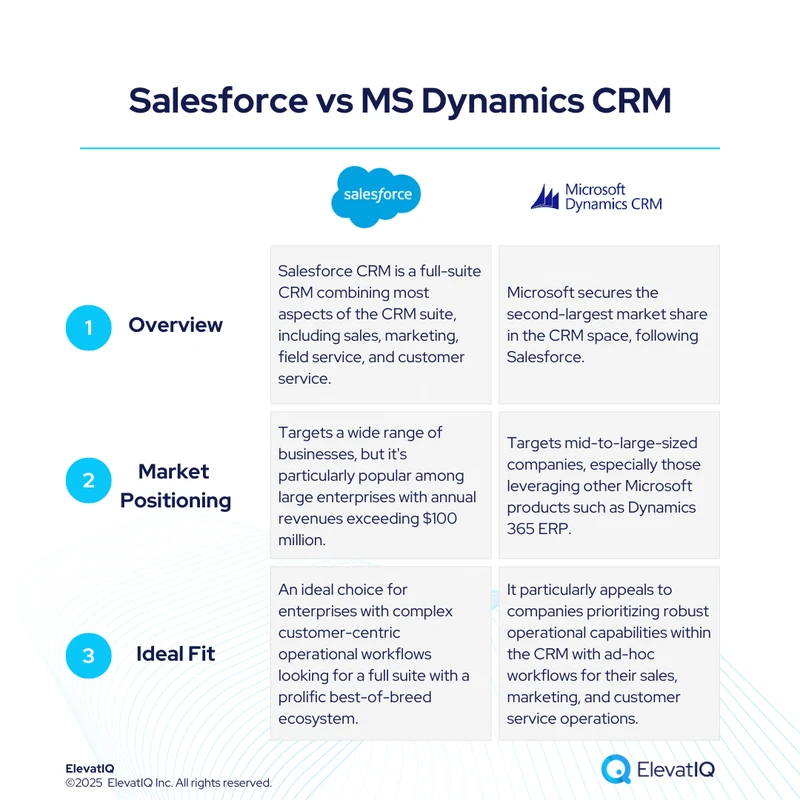
Organizations heavily invested in Microsoft 365 and seeking a unified CRM and ERP architecture at a lower total cost should choose Microsoft Dynamics 365, while organizations prioritizing a specialized, cloud-native CRM with an extensive third-party integration marketplace should choose Salesforce Sales Cloud. The core architectural difference lies in platform scope and ecosystem dependencies. Dynamics 365 combines customer engagement and enterprise resource planning natively within the Microsoft tenant and supports cloud or on-premises deployment, while Salesforce is a pure-play, cloud-only SaaS platform centered strictly on sales, service, and customer data.
Core differences in platform architecture and scope
Both platforms were evaluated and judged on licensing and total cost of ownership, native ecosystem integration, customization and development complexity, and native AI and automation features. Microsoft Dynamics 365 comes with unified CRM and enterprise resource planning within a single operational platform across cloud, on-premises, and hybrid deployments, while Salesforce Sales Cloud operates strictly as a cloud-only SaaS platform focused on sales, marketing, and customer service.
Microsoft Dynamics 365
Microsoft Dynamics 365 starts at $65 per person per month for Sales Professional billed annually (pricing checked in November 2026), scaling to $105 per user per month for Sales Enterprise and $150 per user per month for Sales Premium. The platform connects directly into Microsoft 365, Azure, and Dataverse, using Microsoft Copilot as its primary AI engine. This architecture keeps sales records, productivity documents, and enterprise resource planning data in one security perimeter. However, Dynamics 365 carries administrative complexity across modular application licensing and capacity credits. Organizations deploying Dynamics 365 alongside enterprise resource planning face extended implementation timelines of 6 to 18 months, and on-premises installations suffer from feature lag and reduced functionality compared to cloud deployments.
Salesforce Sales Cloud
Salesforce Sales Cloud starts at $25 per user per month for Starter Suite billed monthly (with a 2-user free plan limit and $100 per user per month for Pro Suite). It scales to $195 per user per month for Sales Cloud Core and $550 per user per month for Agentforce 1 Sales. The product operates on dedicated multi-tenant cloud infrastructure and cannot be deployed on-premises. Its intelligence layer centers on Agentforce grounded in Data 360 to orchestrate customer touchpoints. While Salesforce delivers deep sales-specific workflows out of the box, implementations face post-implementation cost escalation from paid sandboxes, consumption add-ons, and data services. Organizations also face an architectural dependency on external vendors from AppExchange to satisfy operational requirements outside core customer relationship management.
Pricing and licensing costs across tiers
Salesforce offers a lower entry threshold with Starter Suite at $25 per user per month, creating a $40 monthly savings per seat compared to the Dynamics 365 Sales Professional baseline of $65 per user per month ($65 − $25 = $40). At the enterprise level, however, licensing economics reverse in favor of Microsoft Dynamics 365.
A tiered total cost comparison across deployment levels illustrates the software expenditure gap:
- Entry-level sales tier: Salesforce Starter Suite at $25 per user per month gives a low starting price against Dynamics 365 Sales Professional at $65 per user per month, suiting small teams with basic pipeline requirements.
- Core enterprise tier: Microsoft Dynamics 365 Sales Professional ($65 per user per month) delivers a 67% seat licensing reduction relative to Salesforce Sales Cloud Core ($195 per user per month billed annually), while Dynamics Enterprise costs $105 per user per month. For an enterprise team of 100 representatives, Dynamics Enterprise requires $10,500 monthly compared to $19,500 monthly for Sales Cloud Core, saving $9,000 every month on core seats.
- Ecosystem connector overhead: Salesforce environments that need access to Microsoft 365 productivity tools require third-party connectors costing an additional $15 to $30 per user per month, increasing baseline software overhead for every seat.
- Top-tier autonomous AI licensing: Salesforce Agentforce 1 Sales costs $550 per user per month, while Microsoft Dynamics 365 Sales Premium costs $150 per user per month, creating a $400 monthly difference per user for built-in artificial intelligence tooling.
Existing enterprise productivity investments further alter total ownership costs. Organizations operating with Microsoft 365 E3 or E5 licenses already have 40% to 60% of required CRM functionality covered under existing licensing, preventing double-payment for overlapping productivity tools. Unplanned software expenses for sandboxes, premium support tiers, and consumption add-ons have triggered enterprise migrations from Salesforce to Dynamics 365 at organizations including Research Affiliates and iNRCORE.
Ecosystem integration and customization capabilities
Dynamics 365 connects natively without middleware inside the tenant to Microsoft Teams, SharePoint, and Azure, while Salesforce requires third-party connectors ($15 to $30 per user monthly) or tools like Zapier to share data across Microsoft workspaces. Systems integrator HSO noted across client engagements:
“Neither platform loses on core CRM capability. The gap opens in what surrounds the CRM: Microsoft wins on productivity and ERP adjacency, Salesforce wins on marketplace depth and CRM-first specialization.”
Customization approaches and ecosystem breadth divide along the following architectural lines:
- Marketplace availability: Salesforce AppExchange has an ecosystem of over 7,000 integrations, offering a much bigger marketplace of pre-built third-party applications than Microsoft AppSource.
- Development framework: Salesforce custom development relies on proprietary Apex code, Salesforce Flow, and the Lightning Experience interface, requiring specialized platform developers. Dynamics 365 builds on Microsoft Power Platform, using Power Apps, Power Automate, and Dataverse, which allows teams to build low-code extensions using standard enterprise programming skills.
- Deployment duration: Standalone CRM implementations for both platforms require 6 to 12 weeks to complete.
- Enterprise system replacement: Dynamics 365 deployments that replace SAP and unify CRM with enterprise resource planning require 6 to 18 months, compared to standalone SAP implementation timeframes of 18 to 36 months.
HSO observed that Microsoft wins where CRM is only one part of the broader transformation. Teams wanting a focused sales engine with thousands of turnkey third-party plug-ins gain more from Salesforce, while teams unifying sales records with ERP workflows and internal documents gain more from Dynamics 365.
Built-in AI capabilities of Copilot and Agentforce
Salesforce centers its artificial intelligence on Agentforce, launched in September 2024 at Dreamforce and grounded in Data 360, focusing on autonomous customer-facing sales and service interactions. Microsoft weaves Copilot across Dynamics 365, Power Platform, Microsoft 365 productivity applications, developer tools, and Azure to assist internal employee workflows.
Salesforce builds autonomous agents using Agentforce Builder, Flow, and Apex to manage customer touchpoints. Dynamics 365 uses Microsoft Copilot Studio to author low-code agents spanning sales records, operational workflows, and back-office systems. Within daily sales operations, Dynamics 365 Sales incorporates specialized AI tools including Sales Accelerator for prioritizing lead queues, alongside automated tools for automatically logging emails, calls, and tasks directly into customer records.
Technology analyst Dion Kalimeris noted:
“Rather than viewing Salesforce Agentforce and Microsoft Copilot as competitors, it’s more accurate to see them as complementary tools that serve different parts of the business.”
Kalimeris explained that Copilot operates within the Microsoft ecosystem, integrating with tools like Azure, GitHub, and Microsoft 365 across development and business operations, while Agentforce focuses on automated CRM engagement. Organizations choosing between them must decide whether their primary automation target is external customer interaction in Salesforce or internal cross-system operational execution across Microsoft enterprise data.