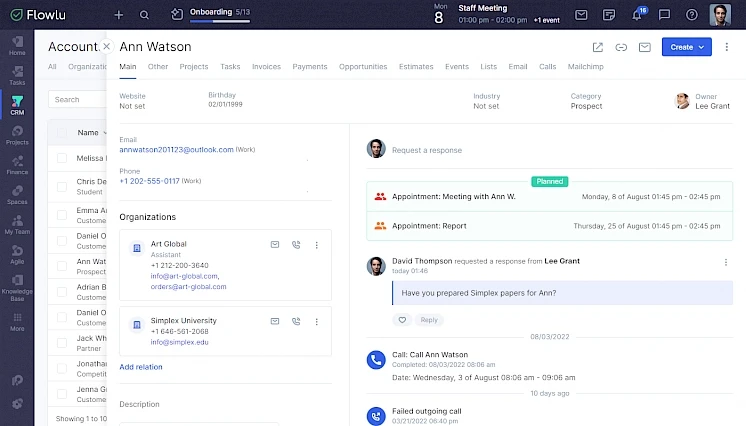
Clio Grow, Lawmatics, and MyCase stand out as the leading CRM platforms for lawyers and law firms, serving solo practitioners seeking direct practice management sync, firms requiring automated intake marketing funnels, and practices wanting an all-in-one legal management suite. These platforms lead the legal market based on native practice management integrations, pre-retention conflict checking, intake e-signature automation, transparent starting pricing, and scalability across firm sizes.
Clio Grow for Solo and Boutique Law Firms
Legal CRM platforms are evaluated by practice management integrations, intake automation and conflict checking, starting price per user, and law firm size fit. Clio Grow comes with client intake and relationship management starting at $49 per user per month (prices checked in November 2026). The platform connects natively to Clio Manage and links into an ecosystem of over 250 third-party legal applications, supported by Clio’s base of over 960,000 active users across North America, Europe, and Asia-Pacific.
Intake automation handles prospective client tracking, online consultation scheduling, digital intake web forms, and document e-signatures. It fits solo practitioners and boutique law firms of 1 to 15 attorneys managing pre-retention workflows. The main limitation is that Clio Grow focuses strictly on pre-retention intake; active matter management and accounting require a separate Clio Manage subscription.
Lawmatics for Automated Legal Intake and Marketing
Lawmatics is a dedicated legal CRM and intake marketing automation platform, with pricing starting at $99 per month. It syncs directly with practice management software including Clio Manage to eliminate duplicate record entry between intake and case opening. Workflows use multi-branch conditional logic forms alongside Qualify AI (in beta), a predictive lead-scoring tool that ranks prospective clients by conversion probability.
The system suits law practices with dedicated marketing teams requiring custom email drip sequences and granular campaign attribution. Because Lawmatics operates strictly as a front-end marketing and intake CRM, it lacks post-retention tools. Firms must integrate third-party practice management software for ongoing case tracking and legal billing.
MyCase for All-in-One Intake and Case Management
MyCase delivers an integrated CRM and practice management suite starting at $50 per user per month billed annually, or $60 billed monthly on the Basic tier, with its Pro tier at $59 per user per month billed annually. It unifies intake pipelines, case files, matter communications, and billing under a single login. The 8am MyCase CRM dashboard centralizes incoming inquiries alongside open case files.
Prospective clients complete intake questionnaires and sign retainers through the integrated client portal using native e-signatures. Completed digital forms and signed agreements transfer directly into open case matters. MyCase is ideal for solo and small law firms seeking software consolidation, though its marketing automation offers less customization than standalone marketing CRMs.
PracticePanther for Unified Law Practice Automation
PracticePanther combines CRM lead capture and law practice management starting at $49 per user per month. The software integrates online intake forms, calendar scheduling, lead status tracking, and matter management within a single platform. Automated task flows trigger when a prospect submits an online form, assigning staff follow-ups and generating document templates to guide prospects toward signed engagement.
The platform is designed to accommodate law firms of all sizes, from solo attorneys to multi-lawyer practices seeking a consolidated operational system. Because PracticePanther prioritizes unified practice management, its CRM features focus on standard matter pipelines and lack predictive lead qualification scoring or specialized external marketing funnels.
Law Ruler for High-Volume Telephony and Intake
Law Ruler has specialized intake automation for law firms of all sizes handling large inquiry volume. Operating within the ProfitSolv software ecosystem, it integrates natively with practice management tools including CosmoLex, Rocket Matter, and Tabs3. The platform features built-in VoIP softphones, automated two-way SMS messaging, and fast digital retainer dispatch to convert prospective clients during initial phone contact.
Real-time intake capture addresses a primary source of lost inquiries: 80% of callers will not leave a voicemail if their call goes unanswered. Law Ruler captures prospects immediately and routes them into active pipelines. The platform delivers maximum operational efficiency when deployed inside the ProfitSolv ecosystem, giving less value to firms using unrelated case tools.
Lead Docket for Personal Injury Lead Conversion
Lead Docket focuses on intake workflow acceleration, marketing campaign tracking, and lead conversion for contingency-fee practices. It integrates natively with Filevine case management to push converted retainers directly into active litigation files. Intake specialists qualify prospects using guided call scripts and automated follow-up sequences, delivering retainer agreements to client smartphones via instant e-signature.
The software is engineered specifically for personal injury and mass tort practices managing heavy inbound lead volume from advertising channels. It tracks marketing source attribution to evaluate campaign return on investment. Lead Docket functions strictly as an intake and lead conversion engine, offering no native post-retention matter management or legal accounting.
Filevine for Litigation Case and Intake Management
Filevine has a case management and legal operations platform tailored to complex litigation practices. For lead intake, it pairs natively with Lead Docket and integrates with Intaker chat tools to capture web inquiries around the clock. The platform comes with customized litigation intake workflows and structured case templates for practice areas such as motor vehicle accidents.
The system is suited for mid-size to large litigation law firms of 10 to 100 lawyers that need deep case customization and cross-team workflow orchestration. The primary operational drawback is setup complexity: deploying Filevine requires extensive configuration timelines spanning several months, making turnkey rollout impractical for small law practices.
CASEpeer for Plaintiff Personal Injury Practices
CASEpeer delivers specialized case management and intake software with pricing starting at $90 per user per month on the Basic tier. The platform includes dedicated personal injury intake pipelines, case tracking, medical records management, and settlement negotiation logs. Pre-built personal injury intake questionnaires capture incident facts, insurance policy details, and statute of limitations dates alongside digital e-signature retainers.
Built exclusively for plaintiff personal injury law firms and litigation boutiques, the software requires minimal initial configuration. Practice area exclusivity is its core limitation: CASEpeer has no compatibility for corporate, transactional, criminal, or family law practices, making it unsuitable for multi-practice firms.
Differences Between Legal CRMs and Standard Sales Software
Standard commercial sales CRMs structure data around linear sales pipelines, while legal CRMs organize records around matter files, partner referral networks, and attorney-client privilege boundaries. A critical functional divergence is pre-retention conflict checking. Legal CRMs enforce automated conflict screening rules that flag potential adverse parties and halt intake pipeline progression until formal conflict clearance is recorded.
Regulatory compliance introduces another major divide. Dedicated legal platforms include trust accounting compliance tools supporting bar requirements across all 50 US states, which generic business platforms lack natively. Adapting generic tools like Salesforce or HubSpot requires custom development whose costs often exceed purpose-built legal software. Furthermore, mandatory manual data entry leads attorneys to abandon generic systems within weeks. According to the 2024 ABA Legal Technology Survey, law firms adopting dedicated legal software achieve 24% reductions in administrative overhead and significantly higher efficiency gains than firms adapting general business tools.
Matching Legal CRMs by Law Firm Size and Software Stack
Solo practitioners and boutique firms of 1 to 15 attorneys benefit most from turnkey all-in-one platforms like MyCase or Clio Grow with Clio Manage. These systems deploy in weeks and replace dedicated operations staff by consolidating client intake, e-signatures, and matter tracking under one interface. High-volume contingency and personal injury practices require specialized intake engines like Lead Docket or Law Ruler paired with Filevine or ProfitSolv systems (CosmoLex, Tabs3, Rocket Matter) to capture incoming callers immediately and stop the 80% inquiry loss caused by unanswered calls. Mid-size law firms of 10 to 100 lawyers with dedicated marketing personnel see strong returns from standalone marketing engines like Lawmatics that sync with existing practice management software.
Matching your firm profile to an optimal software architecture involves three standard deployment models:
- Solo and Boutique Hourly Practices (1–15 attorneys): Deploy an all-in-one architecture using MyCase or Clio Grow with Clio Manage. This path comes with online web forms, intake scheduling, native e-signatures, and trust accounting with minimal configuration.
- High-Volume Contingency Practices (1–25+ attorneys): Deploy an intake-first architecture pairing Lead Docket with Filevine, or Law Ruler with ProfitSolv. This setup emphasizes rapid phone handling, automated SMS follow-up, and instant mobile retainers to stop prospect drop-off.
- Mid-Size Multi-Practice Firms (10–100 attorneys): Deploy a dual-platform architecture connecting Lawmatics to Clio Manage or an enterprise case management hub. This approach adds predictive lead scoring via Qualify AI and multi-channel nurture campaigns without disrupting open case records.
The comparison table below outlines starting prices, practice management integrations, target firm sizes, and primary limitations across the eight legal CRM platforms.
Platform |
Starting Price |
Practice Management Integration |
Target Firm Size |
Key Limitation |
|---|---|---|---|---|
Clio Grow |
$49 per user/month |
Clio Manage (native), 250+ legal apps |
Solo and boutique firms (1–15 attorneys) |
Requires separate Clio Manage subscription for active matters |
Lawmatics |
$99/month |
Clio Manage, third-party practice software |
Firms with dedicated marketing teams |
No post-retention matter management or legal billing |
MyCase |
$50 per user/month (annual billing) |
Built-in all-in-one practice management |
Solo and small law firms |
Less customizable marketing automation funnels |
PracticePanther |
$49 per user/month |
Built-in all-in-one practice management |
Solo to larger multi-lawyer practices |
Lacks predictive lead scoring and external campaign funnels |
Law Ruler |
Vendor-quoted plans |
ProfitSolv (CosmoLex, Rocket Matter, Tabs3) |
High-volume inquiry practices of all sizes |
Maximum efficiency restricted to ProfitSolv applications |
Lead Docket |
Vendor-quoted plans |
Filevine (native) |
Personal injury and mass tort practices |
Intake engine only; lacks matter billing and accounting |
Filevine |
Vendor-quoted plans |
Lead Docket (native), Intaker |
Mid-size to large firms (10–100 lawyers) |
Multi-month implementation and complex configuration |
CASEpeer |
$90 per user/month (Basic tier) |
Built-in personal injury case management |
Plaintiff personal injury litigation firms |
Exclusively limited to personal injury workflows |