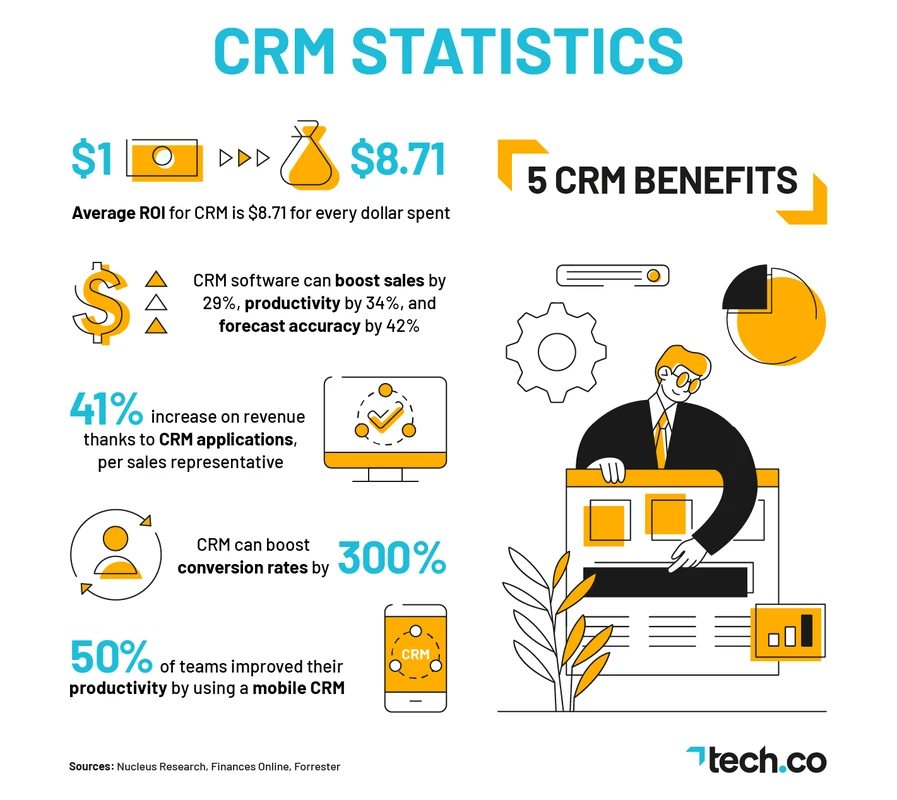
A CRM increases sales productivity by automating non-selling administrative tasks and centralizing customer interaction data into a single operational workflow. Because sales representatives typically spend only 28% of their working hours actively selling while administrative duties consume 40% of their time, eliminating manual data entry, activity logging, and routine scheduling frees up to 20% of team capacity for revenue-generating customer conversations.
How CRM workflows shift rep time toward active selling
Sales representatives spend nearly 28% more time maintaining records than talking to prospects, making administrative upkeep the primary operational drag on selling capacity.
A study on sales time management by InsideSales and CSO Insights revealed that reps spend 17.9% of their working week inside CRM databases and another 9.1% in spreadsheets managing CRM-related tasks. That totals 27% of weekly work hours spent on system administration. Meanwhile, sales reps spend only 28% of their time actively selling, with routine administrative work consuming 40% of their working hours. When sales teams devote more hours to database administration than to prospect meetings, revenue-generating activity stalls.
Automating non-customer-facing administrative tasks breaks this bottleneck directly. Research from McKinsey shows that automating non-customer-facing activities frees up about 20% of a sales team’s capacity. By consolidating interaction histories and prospect details into a centralized platform, teams remove data silos that isolate customer information. Research presented by Rodriguez and Yim at the Academy of Marketing Science Annual Conference demonstrated that CRM utilization improves sales process effectiveness, administrative efficiency, and internal collaboration for sales teams.
Capturing this capacity dividend depends on structured change management. Sales operations practitioner Steve Ancheta pointed out that “if the CRM feels like punishment, adoption drops and the “official” pipeline becomes a work of fiction.” Implementation advisor Mareks Polis explained that adoption failures stem from change management rather than software limitations, noting that sales teams resist systems when they perceive them as an administrative burden rather than a tool that helps them close deals. Designing the CRM as an active workspace that automates record-keeping prevents reps from tracking deals in spreadsheets and keeps pipeline data accurate.
Daily administrative sales tasks that CRM automations remove
Sales workflow automation removes the repetitive handoffs, document creation delays, and manual record updates that fragment a representative’s day.
Core automations eliminate manual intervention across five distinct administrative bottlenecks:
- Inbound lead capture and routing: Automated web capture forms create CRM lead records with channel source attribution. Qualification criteria and routing rules assign prospects by territory or industry immediately, stopping lead drop-off without manual triage.
- Pipeline stage-triggered task management: Workflow automations generate tasks, notifications, and reminders the instant an opportunity changes stage or an inquiry arrives. Prompt next-action triggers prevent deals from stalling and remove reliance on reps manually scheduling every follow-up.
- Automated contract and document generation: Document generation tools pull verified deal information directly from CRM records into pre-approved contract templates. This process eliminates redundant data entry, bypasses legal review delays on standard agreements, and accelerates contract delivery.
- Quote-to-order conversion: CPQ and order management functions allow reps to generate quotes, email them to prospects, track viewing status, and convert accepted quotes straight into work orders without re-entering client details, product configurations, or pricing tiers.
- AI-driven activity logging and note summaries: AI agents autonomously summarize call discussions, extract objections, update records, and draft follow-up emails. Offloading these repetitive administrative routines returns up to 25 hours per week across sales operations.
Removing these administrative duties eliminates the context switching between email inboxes, spreadsheets, and proposal files. When the platform logs customer interactions and updates records automatically, sales representatives focus their working hours on buyer conversations instead of paperwork.
Measurable productivity metrics that improve after CRM adoption
CRM adoption converts reclaimed administrative hours into clear operational velocity and downstream commercial gains across the entire sales cycle.
The productivity impact of CRM automation appears first in leading operational indicators before driving lagging commercial metrics. On the operational side, automating manual logging and spreadsheet upkeep recovers approximately 20% of rep capacity and accelerates daily deal execution. In Salesforce performance benchmarks across 3,887 global customers, organizations that streamlined their sales processes recorded up to a 38% increase in productivity and 26% faster deal closure rates. Reclaiming hours from manual data entry compresses the sales cycle, moving opportunities through pipeline stages without delays between initial outreach, quote delivery, and contract signature.
These reclaimed operational hours produce direct commercial gains in pipeline volume and close rates. Research published by Pipedrive demonstrates that sales professionals who automate routine workflows create twice as many deals and achieve three times the win rate of peers who rely on manual administration. Removing administrative friction gives reps the capacity to manage double the deal volume without losing velocity. Academic research by Thanyawatpornkul found that deploying AI-driven CRM functionalities—specifically automated lead management and predictive analytics—drives a 30% increase in sales conversion rates by directing seller attention toward high-probability opportunities.
Downstream quota attainment reflects these combined efficiency and conversion improvements. Giving sales teams mobile CRM access lets field and remote sellers update deal stages and access client histories from any location. Industry data shows that 24% more sales experts meet their annual quotas when supported by mobile CRM capabilities. Organizations that actively measure implementation return on investment realize these productivity gains within 3 to 6 months of rollout. Replacing manual administration with automated CRM workflows converts lost operational hours into higher deal velocity, larger pipelines, and consistent quota attainment.