SuiteCRM and EspoCRM lead the best open-source CRM software platforms for self-hosting, with SuiteCRM best suited for technical teams with in-house IT that require enterprise customization, and EspoCRM ideal for lean sales operations needing a lightweight, responsive PHP deployment. Across eight evaluated open-source solutions—including Twenty, Frappe CRM, Odoo Community, ERPNext, Atomic CRM, and Krayin—the right choice hinges on your team’s maintenance capacity, preferred language runtime, and database infrastructure.
SuiteCRM for Technical Enterprise Teams
SuiteCRM is best suited for technical teams with in-house IT looking for an enterprise-scale CRM with complex multi-department workflows without recurring per-user licensing fees. These open-source CRM platforms are selected and evaluated by true self-hosting capability, technical maintenance overhead, core feature depth, and the availability of managed hosting. Distributed under the AGPLv3 license, SuiteCRM originated in 2013 as an open-source fork of SugarCRM, shortly before SugarCRM ended its open-source version in 2014.
The application runs on a PHP stack supporting PHP versions 8.1 through 8.4 on Apache or IIS web servers with relational database backends. For organizations that prefer vendor management, commercial hosting packages and enterprise support contracts come directly from maintainer SuiteCRM Ltd. The main operational limitation centers on software maturity: SuiteCRM 8 remains in a levelling up phase and is not yet as feature complete as SuiteCRM 7. Teams testing the system should note that the official public demo discards data every 1 hour via automatic scheduled rebuilds.
EspoCRM for Lean Sales Operations
EspoCRM is best suited for organizations when traditional CRM modules and extensions fit their requirements, managing company relationships, contacts, and opportunities through a responsive interface. Published under the GNU Affero General Public License v3 (AGPLv3), EspoCRM reports adoption by 50,000+ companies across 163 countries, backed by 2.6K GitHub stars and 761 forks. Administrative tools include Layout Manager for configuring entity relationships and fields, Label Manager for interface wording, and Template Manager for standardized messages.
The software runs on a PHP runtime supporting PHP versions 8.3 through 8.5 with an archive download size of 40.5 Mb, with version 10.0.10 released on October 14, 2026. As checked in November 2026, hosted cloud tier pricing starts at Basic for $15/user/mo with a minimum of 3 users, Enterprise for $25/user/mo with a minimum of 5 users, and Ultimate for $69/user/mo with a minimum of 10 users. On-premise deployments have a key limit: visual workflow automation is included in cloud plans but is a paid extension for self-hosted instances. The Advanced Pack and VoIP integration must be purchased separately.
Twenty for Modern Full-Stack Teams
Twenty is released under the AGPL-3.0 open-source license, giving a modern alternative for organizations seeking an adaptable data model and visual workflow engine. Built for contemporary web environments, the technology stack uses Node.js, Nest.js, TypeORM, PostgreSQL, Redis, React, and TypeScript. Developers can scaffold custom extensions containing objects, server logic functions, and React interface components using the Twenty Apps CLI command npx create-twenty-app.
Within the application, the Settings menu allows administrators to create custom objects, fields, views, and visual workflows directly without writing code. User AC&T documented a 90% CRM cost reduction after moving to a self-hosted instance of Twenty. For teams preferring managed infrastructure, Twenty Cloud offers a 30-day trial. When importing data volumes of 50,000+ records, the platform recommends using API integration instead of standard CSV uploads. The core limitation is operational capacity: Twenty includes only 50 workflow credits/year, and workflows currently lack native mobile accessibility.
Frappe CRM for Social Lead Capture
Frappe CRM is best suited for lean sales teams that want an adaptable, open-source CRM with modern usability and low license pressure. Built on the Python-based Frappe Framework, the project commands 3.6K GitHub stars and followers. It connects directly with social acquisition channels through Settings > Lead syncing, which configures automated lead syncing from Facebook and Instagram to pull incoming Meta leads with full details straight into active pipelines.
Sales teams can modify deal and lead forms directly using the Edit Field Layout interface to add custom fields and restructure tables. For deeper operational logic, developers can implement automation using pluggable Python scripts supported by the underlying framework. The primary operational drawback of Frappe CRM is its maturity compared with long-established enterprise CRM platforms, meaning teams find fewer third-party integrations and pre-built business plugins out of the box.
Odoo Community for Modular Business Apps
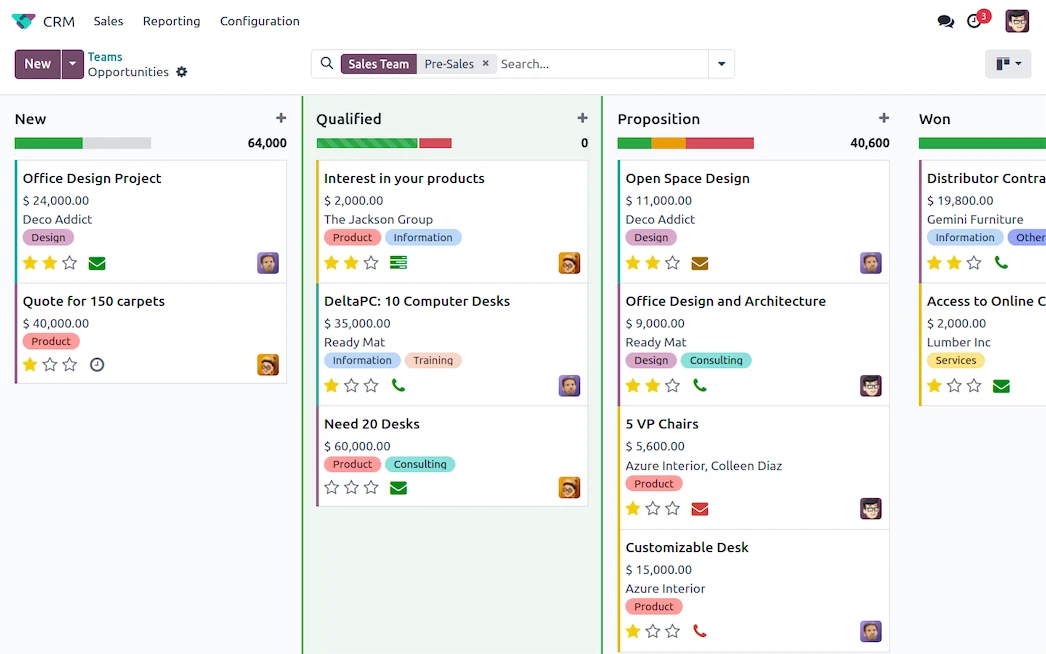
Odoo Community is best suited for organizations that want to integrate CRM contact and opportunity management within a broader business management suite. Backed by 47.0K stars and 30.3K forks on GitHub, the platform functions on a Python and PostgreSQL architecture. It connects pipeline management directly with operational apps spanning billing, e-commerce, warehouse logistics, and inventory tracking under a shared data structure.
Deployments can run entirely on-premise, while Odoo cloud options have a free tier with an allowance of 1 app for single-module setups before paid upgrades take effect. The main limitation of Odoo Community is functional gating: the self-hosted edition lacks critical enterprise capabilities including the official mobile app, advanced accounting reports, and the Odoo Studio customization tool. Teams requiring code-free visual screen alterations or mobile pipeline access must either build custom community workarounds or upgrade to proprietary enterprise licenses.
ERPNext for On-Premise Enterprise Control
ERPNext is distributed under the GPL-3.0 license, delivering an open-source platform covering sales pipelines alongside complete enterprise resource planning. The application architecture runs on Python, MariaDB, and the Frappe framework. Managed cloud hosting options exist across the Frappe and ERPNext ecosystem for organizations seeking external infrastructure management without self-hosting the underlying servers.
ERPNext is best suited for deployments when you have a dedicated, experienced DevOps team, your industry requires on-premise data residency by law, and you have the budget and patience for a proper setup. Its primary pitfall emerges when scoping: implementing ERPNext exclusively for standalone CRM needs results in rigid workflows and implementation overhead compared to dedicated CRM tools. Because the platform coordinates manufacturing, inventory, and accounting, configuring it solely for contact tracking introduces unnecessary operational complexity.
Atomic CRM for Developer Starter Kits
Atomic CRM was created by Marmelab as a minimalist open-source CRM maintained at approximately 15k lines of code. It is designed to serve as a developer starter kit that is easy to customize, deploy, and maintain for basic sales tracking. With minimal resource overhead, technical users can self-host instances on small virtual private servers or even a Raspberry Pi without heavy infrastructure commitments.
Hosting focuses exclusively on direct self-hosting and source code modification; the project offers no official paid hosted cloud version. The primary trade-off of this lightweight footprint is connectivity: out-of-the-box third-party connectivity is limited, requiring engineering teams to build custom connectors to integrate with external email services, marketing platforms, or data warehouses.
Krayin for Laravel PHP Environments
Krayin is published under the permissive MIT License by Webkul, commanding an open-source community repository with 20,000+ GitHub stars. The backend runs on Laravel 10 (PHP), paired with a Vue.js frontend, MySQL or MariaDB for database storage, and Laravel Queue backed by Redis or a relational database for background job processing. Commercial enterprise support and bespoke development are offered directly by Webkul alongside community self-hosting.
The platform is best suited for technical organizations and developers comfortable with PHP who require complete architectural control under an unrestrictive MIT license that allows proprietary embedding. The main limitation is reporting depth: built-in win rate reporting and sales pipeline analytics are functional but basic compared to dedicated commercial CRM suites, requiring custom dashboard development for complex metrics.
Hosting Requirements, Features, and Licensing Compared
Platform |
License |
Primary Tech Stack |
Best Suited For |
Key Limitation |
|---|---|---|---|---|
SuiteCRM |
AGPLv3 |
PHP (8.1–8.4), Apache/IIS, SQL DB |
Technical teams with in-house IT |
SuiteCRM 8 leveling up; public demo resets hourly |
EspoCRM |
AGPLv3 |
PHP (8.3–8.5), MySQL/MariaDB |
Traditional CRM module operations |
Paid workflow automation on self-hosted; separate VoIP |
Twenty |
AGPL-3.0 |
Node.js, Nest.js, PostgreSQL, Redis, TypeScript |
Teams wanting visual schema customization |
50 workflow credits/year limit; no mobile app |
Frappe CRM |
Open Source |
Python, Frappe Framework, MariaDB |
Lean sales teams needing Meta lead sync |
Platform maturity compared to legacy suites |
Odoo |
Open Source |
Python, PostgreSQL |
Multi-department operations and ERP apps |
Community version lacks mobile app and Studio tool |
ERPNext |
GPL-3.0 |
Python, MariaDB, Frappe Framework |
Teams needing legal on-premise data residency |
Rigid overhead when used solely as a CRM |
Atomic CRM |
Open Source |
Node.js / React (~15k LOC) |
Developers wanting a starter kit on a small VPS |
No paid cloud tier; limited external connectors |
Krayin |
MIT License |
Laravel 10 (PHP), Vue.js, MySQL/MariaDB |
PHP developers needing unrestrictive licensing |
Basic native pipeline analytics and win rate reporting |
Selecting the Right CRM for Your Tech Stack and Team
Organizations with dedicated DevOps engineers that must maintain on-premise data residency by law should choose ERPNext, provided they require full business operations and have the resources for a multi-stage setup. Technical teams with in-house IT seeking enterprise scalability across multiple departments should select SuiteCRM to eliminate recurring seat licensing while maintaining deep workflow customization.
PHP development shops requiring complete source modification freedom without copyleft restrictions should deploy Krayin under its MIT license. If your organization prefers a mature PHP foundation with straightforward CRM entity modules and optional managed cloud tiers, EspoCRM is the practical choice.
Engineering teams standardized on modern JavaScript runtimes should select Twenty for its TypeScript, React, and PostgreSQL architecture, using the Settings menu for visual data modeling while accounting for its 50 workflow credits limit. Lean sales operations prioritizing fast deployment and native Facebook and Instagram lead capture should select Frappe CRM. For individual developers seeking a minimalist starter kit that runs on a small virtual private server or a Raspberry Pi, Atomic CRM delivers a compact foundation with minimal resource overhead.