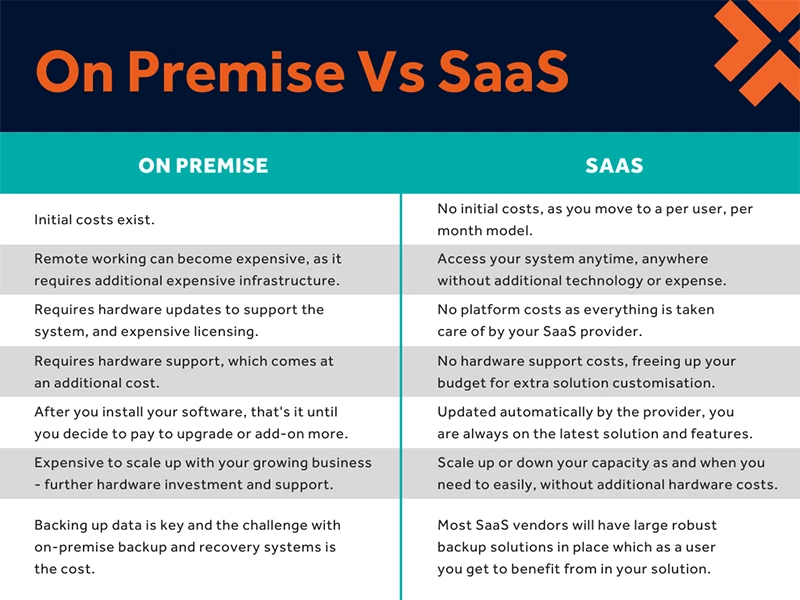
SaaS CRM is the right choice for organizations prioritizing rapid deployment, low upfront capital expense, and vendor-managed infrastructure, while on-premise CRM suits large enterprises with existing data centres or strict regulatory mandates that prohibit third-party data hosting. The foundational difference centers on hosting architecture and operational ownership: SaaS CRM runs entirely on vendor cloud servers accessed through web browsers or mobile apps, while on-premise CRM installs directly on company-owned servers within a private data center. Cloud deployments activate within hours to days and scale user seats on demand, but depend on continuous internet connectivity and recurring subscriptions. In contrast, on-premise installations require weeks to months to implement and demand dedicated internal IT maintenance, but grant full direct control over physical data residency and maintain local operational stability even during internet disruptions.
Architectural differences between SaaS and on-premise CRM
SaaS CRM
SaaS CRM runs on vendor-managed cloud infrastructure accessed through web browsers and mobile apps. Organizations deploy within hours to days and adjust user seats in minutes without purchasing hardware. According to Gartner, the average mid-market business runs 87 SaaS applications, and cloud CRMs integrate with these tools through pre-built connectors and standard APIs in ways that on-premise CRMs typically do not. The operational trade-off is an absolute dependence on continuous internet connectivity: if the network connection fails, user access to customer records stops.
On-Premise CRM
On-premise CRM installs locally on company-owned servers inside a private data center. Implementation takes weeks to months, requiring physical server setup and database provisioning before users log in. Expanding user capacity requires purchasing and provisioning additional hardware. This local architecture maintains operational continuity in locations where internet access is unavailable or unreliable. However, remote staff access requires internal VPN configuration and network management to route traffic into the corporate data center.
Comparing upfront capital and long-term ownership costs
Evaluating CRM expenditures requires analyzing the total cost of ownership across a three-to-five-year evaluation window rather than contrasting initial license fees directly against recurring subscription rates. As VARStreet notes, “The right comparison isn’t the license price versus the subscription price. It’s the total cost of ownership over the period you expect to use the system.” Pricing structures (checked as of November 2026) depend on how capital and operational budgets are balanced over that period.
SaaS CRM follows an operational expenditure model characterized by low initial costs. Organizations pay recurring monthly or annual subscription fees per user that scale directly with team size. While initial capital outlay is minimal, subscription fees compound over time as user counts increase and data storage expands.
Significant upfront capital expenditure is required for perpetual software licenses, server hardware purchases, and initial setup with on-premise CRM. Over a three-to-five-year timeframe, recurring expenses for hardware maintenance, internal IT salaries, upgrade licenses, and downtime risk can close the cost gap with cloud subscriptions. However, the financial tipping point favors on-premise deployments in large-scale operations. According to TRG international, for very large organizations with the economies of scale to efficiently run their own data centres, on-premises solutions may offer a lower TCO. For these enterprises, established data center infrastructure and fixed staffing absorb the administrative burden, making perpetual licenses cheaper than compounding per-user cloud fees.
Data control, security boundaries, and regulatory compliance
Organizations get complete, direct internal control over physical data residency, encryption keys, retention schedules, and access policies with on-premise CRM. Customer information remains within company-owned servers and private networks. In specific industries, strict regulatory frameworks and data security rules legally prohibit organizations from engaging third-party cloud SaaS providers in customer data handling. For these regulated environments, self-hosted infrastructure is mandatory.
SaaS CRM stores records within vendor-managed cloud environments where data governance is shared. System security, tenant isolation, and regulatory compliance are governed through third-party certifications, contractual terms, and vendor security audits. While cloud vendors maintain specialized security defenses, the customer delegates physical custody of customer databases and relies on vendor controls to enforce data protection.
IT staffing, infrastructure upkeep, and ongoing maintenance
SaaS CRM shifts routine infrastructure maintenance to the provider. The vendor manages software upgrades, security patching, routine backups, and disaster recovery automatically in the background without requiring internal IT labor. This hands-off model frees internal technology personnel from server administration and emergency troubleshooting.
The entire operational burden falls on internal IT teams with on-premise CRM. Dedicated personnel must manage physical server maintenance, patch application, routine data backups, and disaster recovery planning. Ensuring that on-premise servers and hardware operate continuously can require around-the-clock IT administrative attention. In addition, integrating an on-premise CRM with broader company software often requires internal developers to build and maintain custom integration code from scratch due to a lack of pre-built connectors. Organizations selecting on-premise software must account for these sustained staffing demands.