Manatal suits budget-conscious teams needing an affordable dual ATS and CRM starting at $15 per seat monthly, while Gem suits growing talent teams that need proactive outbound sourcing layered directly over their existing ATS. For organizations wanting an all-in-one hiring platform, Lever combines native CRM candidate nurturing with applicant tracking. These options were selected and evaluated based on ATS integration flexibility, automated talent pooling, pricing clarity, and implementation effort across varying hiring volumes.
Top Recruitment CRMs for HR Teams Compared
Recruitment CRM platforms were shortlisted and evaluated based on ATS integration depth, automated candidate engagement, talent pooling, pricing transparency, and implementation requirements. The comparison table below outlines starting costs (checked in November 2026), trial terms, integration methods, ideal team fit, and key limits to help recruiters shortlist the right tool by hiring volume.
| CRM Platform | Starting Price | Trial or Demo | ATS Integration Model | Best For | Main Drawback |
|---|---|---|---|---|---|
| Manatal | $15/seat/month (annual billing) | 14-day free trial (no credit card) | Built-in native ATS | Small teams and databases under 10,000 candidates | Capped at 15 live jobs on Professional tier |
| Gem | $99/user/month (Essentials) | Product demo | External sync (Workday, Greenhouse, SmartRecruiters) | High-growth outbound sourcing teams | Unlisted custom pricing for advanced tiers |
| Lever | Custom annual quote | Product demo | Unified native ATS and CRM (400+ integrations) | Mid-sized teams wanting a single platform | Requires replacing current ATS |
| SmartRecruiters | Modular pricing by tier | Product demo | Native CRM inside SmartOS suite | Enterprises with 250+ employees | CRM sold as a separate add-on product |
Manatal for Low-Cost Sourcing and Small Teams
Manatal gives small talent teams both recruitment CRM and applicant tracking capabilities starting at $15 per seat per month when billed annually on the Professional tier. A 14-day free trial runs without requiring credit card details, letting recruiters test pipeline management and candidate sourcing before committing.
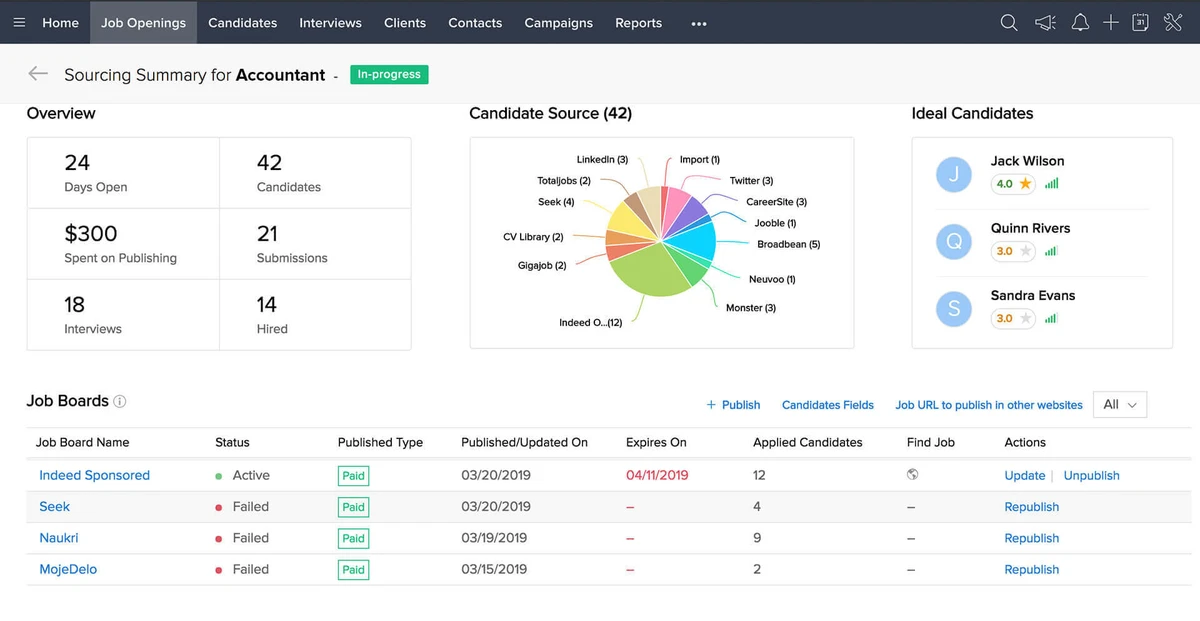
The platform includes built-in applicant tracking alongside an interactive home dashboard that shows upcoming recruiting activities on the left and pipeline analytics on the right. It fits small in-house teams and organizations managing databases of over 500 candidates that require automated sourcing workflows on a lean budget.
The primary drawback is the Professional tier ceiling of 15 live jobs and 10,000 candidates. Crossing either threshold forces an upgrade to the Enterprise tier at $35 per seat per month, or Enterprise Plus at $55 per seat per month.
Gem for Dedicated Sourcing Over an Existing ATS
Gem works as a dedicated candidate relationship management layer that connects directly to an existing hiring infrastructure. Published entry rates start at $99 per user per month on the Essentials staffing plan and $270 per month on the Startups in-house plan, while access to advanced recruiting tiers requires scheduling a product demo with sales.
The platform syncs bi-directionally with major ATS systems, including Workday, Greenhouse, and SmartRecruiters, pulling candidate records and tracking sourcing stages without creating data silos. This setup suits fast-growing recruiting teams that maintain dedicated sourcing capacity and need to engage passive talent without replacing their established system of record.
The main limitation is commercial opacity on upper tiers. Teams looking for enterprise-grade pipeline features cannot evaluate transparent pricing up front and must complete sales consultations to receive custom quotes.
Lever for Unified Sourcing and Applicant Tracking
Lever delivers candidate relationship management and applicant tracking inside a single, unified platform rather than syncing two separate software systems. Pricing is arranged through custom annual contracts following a scheduled product demo.
The system features more than 400 ecosystem integrations across HRIS, sourcing, background check, and productivity tools. Within the candidate profile view, built-in talent fit indicators display qualifications and profile insights directly alongside past engagement history. Lever suits mid-sized companies seeking to manage candidate pipelines, nurture campaigns, and hiring team collaboration under a single software agreement.
The key trade-off lies in its architecture. Because Lever unifies the ATS and CRM natively, adopting its relationship features requires replacing your existing ATS rather than attaching a modular overlay to your current tools.
SmartRecruiters for Enterprise Hiring and Compliance
SmartRecruiters comes with enterprise-grade candidate relationship management built directly into its broader SmartOS hiring suite. Pricing follows a modular structure based on hiring volume tiers, with the CRM and onboarding modules sold as add-on products after an initial product demo.
The native integration between applicant tracking and candidate relationship tools lets teams organize segmented talent pools, capture prospective candidate profiles, and run branded communication campaigns from the same system. The software suits mid-sized to large organizations with 250 or more employees that require multilingual capabilities and regional data compliance across international recruitment operations.
The main drawback is commercial complexity. Candidate relationship management is not included in the baseline system, meaning talent acquisition leads must negotiate and budget for separate modular licenses and add-on agreements.
Key Differences Between a Recruitment CRM and an ATS
An ATS manages active inbound applicants moving through structured evaluation and interview stages for an open requisition, operating across cycles of several weeks. A recruitment CRM manages outbound engagement with passive prospects who have not applied, sustaining relationships across months and years.
While an ATS captures candidate details only after an individual applies, a CRM holds profiles from sourcing outreach, campus events, and previous candidate pools. When a candidate is rejected or finishes as a near miss, records flow from the ATS back into the CRM so relationships do not decay into dormant spreadsheets. Full CRM implementations run between two and six months, depending on candidate data migration quality and ATS synchronization depth.
To choose the right software architecture, evaluate your team against three operational thresholds:
- ATS alone: Teams making fewer than 50 hires per year with no dedicated sourcers can rely on an ATS with basic nurture features to handle incoming applicants.
- Dedicated CRM overlay: When active candidate pools pass 500 people and teams employ dedicated sourcers, adding an overlay like Gem over an existing ATS such as Workday or Greenhouse enables targeted outbound pipelines without system disruption.
- Unified ATS and CRM platform: Teams replacing an outdated ATS or scaling hiring across multiple departments gain efficiency by adopting a single platform like Lever or SmartRecruiters to run sourcing, tracking, and evaluation in one shared database.
Essential Features in an HR Recruitment CRM
An HR recruitment CRM must have six core operational capabilities to organize prospective talent and maintain consistent communication ahead of hiring demands.
- Centralized talent database: Structured candidate profiles with resume parsing and chronological communication histories give a single source of truth for every prospect.
- Talent pool segmentation: Custom tags and skill attributes group candidates into specialized pipelines based on department, seniority, certifications, or geographic region.
- Multi-channel nurture campaigns: Automated, scheduled email and SMS messaging sequences maintain regular contact with passive prospects, preventing candidate drop-off that reaches 60 percent when prospects wait more than two weeks without communication according to Staffing Hub.
- Applicant rediscovery workflows: Search tools surface past applicants and silver medalists when new requisitions open, helping organizations raise internal database hiring above the common 30 percent placement threshold documented by Bullhorn.
- Bi-directional ATS synchronization: Direct data pipelines ensure candidate notes, application updates, and interview stages transfer between outbound sourcing workflows and formal hiring funnels.
- Recruitment marketing analytics: Reporting dashboards track campaign open rates, reply metrics, and pipeline depth across specific skill categories and sourcing channels.