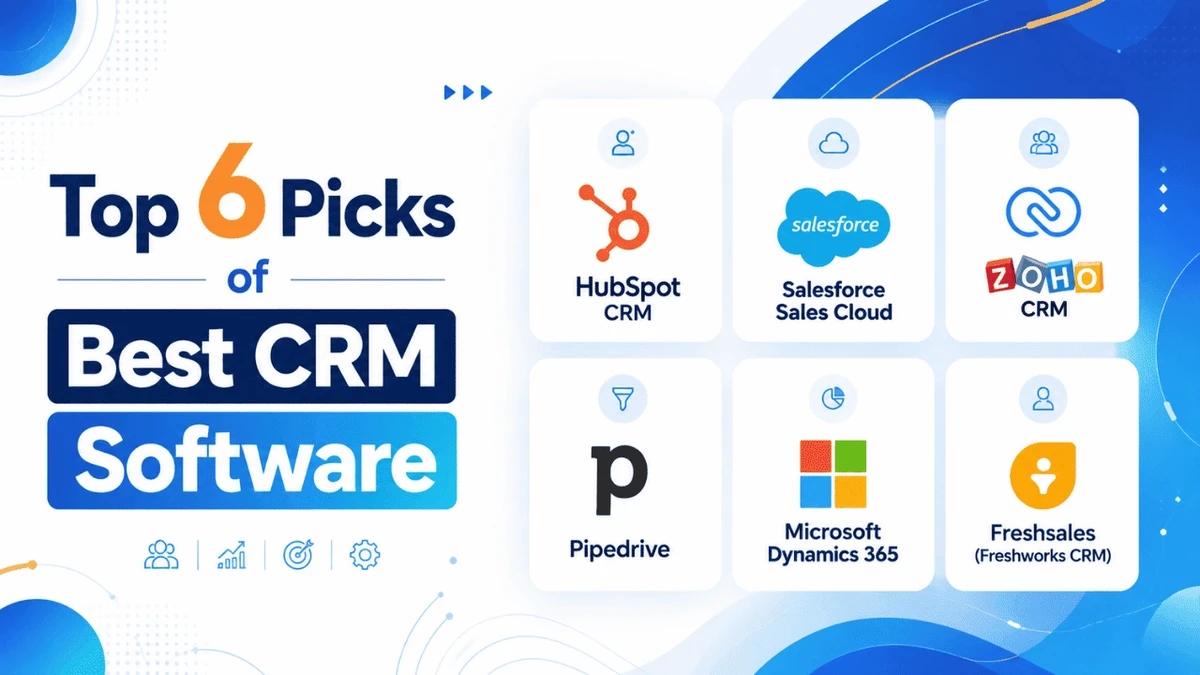
HubSpot CRM suits scaling teams seeking an all-in-one marketing, sales, and service platform, Attio is best for lean product-led growth startups, and Salesforce Sales Cloud serves enterprise sales-led organizations. These platforms lead the SaaS market alongside Pipedrive and Close based on native subscription billing alignment, product usage telemetry tracking, and predictable seat-cost scaling.
Top CRM Platforms for SaaS Companies
HubSpot CRM
HubSpot CRM unites marketing, sales, and service teams on a single codebase, so customer data flows across lead records, deal stages, and support tickets without complex integrations. Pricing starts at $15 per user per month on the starting paid plan (prices checked in November 2026), with standard seats starting at $20 per seat per month. For a 10-user team, licensing costs $900 per month on Sales Pro and $1,500 per month on the Enterprise tier.
HubSpot connects with roughly 2,000 marketplace applications. For SaaS companies tracking in-app events, teams connect cloud data warehouses like BigQuery to HubSpot in 30 minutes via reverse ETL tools like Hightouch to sync product telemetry into account records. The main scalability limit is a cap of 1,000 custom properties per object, restriction of custom objects to the Enterprise tier, and steep cost escalation as contact lists and seats grow.
Attio
Attio is a data-native CRM designed for product-led growth teams with under 50 people. Implementation takes one to four weeks, with teams often completing rollout in two weeks: setting up initial workspaces in week one, then refining automations, custom views, and data structures in week two.
Pricing starts at $36 per seat per month after the free tier. For a 10-user team, plans cost EUR 310 (about $342) on Plus and EUR 740 (about $817) on Pro monthly. Attio features an API-first architecture with native custom objects available across all paid tiers to ingest product telemetry directly into account records. The main trade-off is go-to-market scope: the platform connects to your existing marketing stack rather than offering native landing pages or email marketing tools. The free tier caps usage at 3 seats with restricted object types and no automation sequences.
Salesforce Sales Cloud
Salesforce Sales Cloud serves enterprise sales-led SaaS companies with dedicated RevOps teams managing complex multi-stakeholder pipelines. Pricing begins at $25 per user per month on the Starter Suite, escalating to $300+ per user per month on upper-tier enterprise editions.
Salesforce features deep automated workflows via Flow Builder and an extensive enterprise ecosystem on AppExchange, acting as the primary system of record that specialized PLG CRMs write data back into. The main operational constraint is administrative overhead: Salesforce requires at least one experienced administrator or team to maintain, which risks costly rework if implemented prematurely.
Pipedrive
Pipedrive focuses on sales pipeline management and deal velocity, making it suitable for early-stage sales-led startups running simple outbound motions. Its visual deal interface keeps sales representatives focused on executing core pipeline activities without interface clutter.
Pipedrive Lite plan pricing starts at $24 per user monthly (billed monthly), with entry pricing available from about $14 per user per month on annual billing. Pipedrive gives teams visual pipeline tracking and add-on sales campaign tools, but focuses strictly on sales pipeline management rather than multi-channel marketing. It lacks built-in native objects for tracking product usage, plan tier levels, or renewal dates, and gives only a time-limited free trial rather than an ongoing free tier.
Close
Close is an inside-sales CRM optimized for early-stage B2B SaaS teams running high-volume outbound calling and email sequences. It centers sales execution inside lead cards to keep representatives focused on outreach velocity.
Close Solo plan pricing starts at $19 per user per month (or $9 per user per month billed annually). The platform includes native calling, predictive dialing, and email sequences directly within deal cards for rapid outreach. However, Close maintains a narrow focus on outbound communication tools, excluding full-lifecycle marketing automation, customer service ticketing, and native subscription billing tracking.
Feature, Pricing, and Integration Breakdown
CRM Platform |
Starting Price & Tier |
Key Integrations & Architecture |
Primary GTM Motion |
Scalability Constraint |
|---|---|---|---|---|
HubSpot CRM |
$15/user/month (Starter) or $20/seat/month |
~2,000 marketplace apps; reverse ETL sync with BigQuery |
Hybrid PLG and sales-led |
1,000 custom properties per object; steep contact tier jumps |
Attio |
$36/seat/month (Plus tier) |
API-first architecture; native custom objects for telemetry |
Product-led growth (PLG) |
Free plan capped at 3 seats; no native marketing nurture |
Salesforce Sales Cloud |
$25/user/month (Starter) to $300+/user/month |
Flow Builder; AppExchange enterprise marketplace |
Enterprise sales-led |
High administrative overhead; requires dedicated RevOps team |
Pipedrive |
$24/user/month (Lite monthly) |
Visual pipeline tracking; campaign add-on tools |
Early outbound sales-led |
No native objects for usage telemetry, plan tiers, or renewals |
Close |
$19/user/month (Solo monthly) |
Native calling, predictive dialer, and email sequences |
High-volume inside sales |
Lacks full-lifecycle marketing, ticketing, and billing tracking |
Choosing a CRM for PLG Versus Sales-Led Motions
Product-led growth CRMs ingest telemetry data so actual customer product usage dictates deal stages rather than sales call activity. Traditional CRMs fail to capture user journeys, trial activity, or non-paying accounts prior to payment, creating blind spots for GTM teams. A dual-track pipeline architecture divides customer journeys into an automated self-serve pipeline and a sales-assisted pipeline for high-touch accounts.
Setting up a product-led CRM in HubSpot using cloud data warehouses like BigQuery and reverse ETL tools like Hightouch takes 30 minutes, avoiding custom engineering maintenance. Tejas Manohar, CEO of Hightouch, notes that reverse ETL is the process of copying data from a cloud data warehouse to operational systems of record. Lars Grønnegaard, Dreamdata CEO, confirmed the result: “Thanks to our data platform and HighTouch our Hubspot is now a product-led CRM.”
Use these operational criteria to map your SaaS motion to the right platform:
- Early sales-led outbound velocity (Close or Pipedrive): Pick Close for integrated calling, predictive dialing, and email cadences handled directly inside deal views. Pick Pipedrive when running simple sales stages centered on manual activity tracking and deal velocity.
- Lean product-led growth under 50 headcount (Attio): Deploy Attio to achieve a rapid rollout in one to four weeks with native custom objects for telemetry. Author and RevOps implementer Abhishek Singla summarized this stage boundary: “Attio for lean teams under 50 people. HubSpot once cross-functional sales, marketing, and service alignment matters.”
- Hybrid cross-functional scaling between $5M and $15M ARR (HubSpot): Graduate to HubSpot when unifying marketing lead flows, sales pipelines, and customer support on a single codebase outweighs lightweight administration. Connecting BigQuery via Hightouch brings telemetry directly into standard deal records.
- Enterprise sales-led governance (Salesforce Sales Cloud): Move to Salesforce when complex buying committees, multi-tier approvals, and deep custom logic require dedicated RevOps administrators using Flow Builder.
Conversions use a rate of 1 EUR = $1.10 as of November 15, 2026; rates may change.