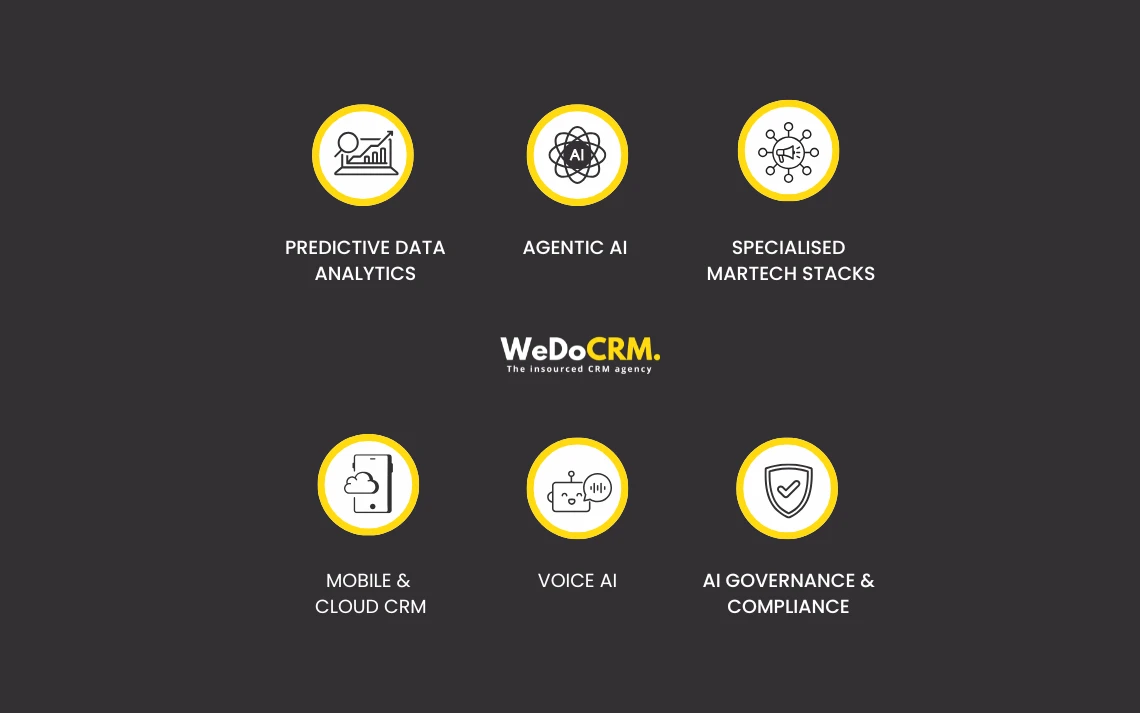
In 2026, customer relationship management is undergoing a structural shift from passive data tracking to autonomous operational execution. Driven by production multi-agent systems, composable API architectures, and consumption pricing, modern CRMs independently orchestrate workflows, monitor pipeline health, and engage buyers across digital workspaces.
Industry research confirms this fundamental transformation. Kate Leggett, Forrester analyst, observes that “CRM in 2026 is undergoing a structural shift, not just an incremental evolution,” an assessment corroborated by Gartner data projecting that 40% of enterprise applications will feature task-specific AI agents by the end of 2026. Gartner also projects that 80% of enterprises will have deployed generative AI in production environments within the same timeframe. Rather than functioning as static digital address books, modern platforms operate as execution layers. As implementation specialists at Frigat NET observe: “Modern CRM has already evolved beyond being a simple customer database. Today, it is a technological system that helps companies navigate data faster, build customer relationships more precisely, and use resources more rationally.” For enterprise revenue leaders and architects, capitalizing on this transition requires moving beyond superficial chat assistants to reconstruct technical architectures, governance standards, and operational workflows.
The Evolution from Passive Databases to Autonomous AI Agents
In 2026, CRM platforms are shifting from passive data repositories to proactive execution engines driven by autonomous agentic AI. Rather than merely summarizing records or drafting text, specialized agents independently verify identities, execute threshold-governed refunds, continuously monitor pipeline health, and orchestrate complex customer workflows across disparate enterprise software tools.
The enterprise market has moved past the experimentation that defined earlier adoption cycles. Industry reporting documents that agentic AI advanced from experimental pilots in 2025 to production enterprise rollouts in 2026. Forrester data indicates that 70% of companies already deploy AI capabilities within their CRM systems. The operational dividing line in 2026 centers on execution agency. Assistive copilots require human operators to prompt, review, and manually execute every recommendation. Production agents in 2026 operate asynchronously across enterprise boundaries, initiating actions based on system events, incoming webhooks, and real-time behavioral signals.
Autonomous support resolution illustrates this operational transition in customer service environments. Enterprise architecture guides detail how agentic systems resolve disputes end-to-end without representative involvement:
- Deterministic Identity Verification: Agents validate inbound customer identities against enterprise directory records, transaction histories, and multi-factor authentication tokens.
- Independent Policy Adjudication: The system queries external billing systems and service logs to evaluate refund eligibility against contractual terms.
- Threshold-Governed Financial Execution: When transactions meet predefined business rules, the agent triggers payment gateways to issue credits or refunds without human routing.
- Cross-Platform Ledger Synchronization: The agent updates CRM records, logs audit details, closes support tickets, and notifies account owners across communication channels.
Within revenue operations, autonomous agents alter pipeline inspection routines. Technical evaluations emphasize how autonomous agents continuously evaluate deal progression against historical win patterns. Instead of waiting for sales reps to update opportunity stages during weekly reviews, agents monitor buyer participation, email cadence, and contractual redlines. Solution architects at Symantra model these interactions through predictive customer lifecycle triggers. When an agent detects a decline in buyer response frequency or notes that key decision-makers have exited the communication loop, it schedules re-engagement tasks, alerts the deal desk, or adjusts revenue forecasts in real time.
Why Composable Ecosystems Are Displacing Monolithic Suites
Enterprise software procurement has departed from closed, monolithic application suites in favor of modular, API-first composable CRM stacks. As highlighted in a 4CRMs analysis, “Modular CRM ecosystems beat all-in-one platforms.” Legacy all-in-one platforms historically promised unified data structures, yet often delivered rigid relational databases that restricted workflow flexibility and impeded external software connections.
The economic performance of integrated architectures validates this architectural pivot. Industry benchmark data published by Sopro reveals that organizations deploying integrated systems achieve 35% annual recurring revenue (ARR) growth, compared to only 19% for businesses operating standalone CRM software in isolation. Sopro reports that connecting CRM infrastructure directly with lead generation engines lifts average conversion rates to 52%, up from a 34% baseline, while driving a 95% net revenue retention rate. Sopro benchmarks also show that 45% of commercial teams purchase software specifically to improve integrations across their technical stacks. Concurrently, Gartner projects that 80% of enterprise sales cycles will involve at least one shared digital workspace by the end of 2026. These shared digital environments replace fragmented email exchanges by providing a synchronized workspace where corporate buyers, account executives, and autonomous agents collaborate on deal terms, technical evaluations, and implementation roadmaps.
Platform vendors have responded to this demand by tailoring their architectures toward distinct operational profiles, balancing proprietary deep stacks against open composability. The following comparison highlights how primary enterprise platforms structure agent orchestration, integration models, and core focus areas in 2026.
Platform Provider |
2026 AI Agent Architecture |
Ecosystem Strategy |
Target Operational Focus |
|---|---|---|---|
SAP |
Autonomous enterprise orchestration via Joule Studio and SAP AI Agent Hub |
Deep enterprise integration across enterprise resource planning, supply chains, and procurement modules |
Cross-departmental business process execution, supply chain alignment, and financial reconciliation |
Microsoft Dynamics 365 |
Vertical enterprise agents incorporating multi-model reasoning and IoT telemetry fusion |
Composable cloud fabric bridging productivity software, data clouds, and enterprise services |
Complex field service dispatch, relationship intelligence, and equipment lifecycle tracking |
Pipedrive |
AI Sales Assistant embedded natively within pipeline management interfaces |
Targeted mid-market architecture with pre-built application integrations |
Deal velocity optimization, automated activity logging, and sales administrative reduction |
These structural choices determine whether revenue teams remain dependent on a single vendor’s product releases or retain the ability to swap specialized best-of-breed components as agentic standards evolve. Revenue architects prioritizing flexibility increasingly build around modular interfaces that permit frictionless integration across external data layers and specialized workflow tools.
The Commercial Shift to Outcome and Usage-Based CRM Pricing
The widespread deployment of autonomous software agents has made traditional per-seat subscription licensing commercially obsolete. For three decades, enterprise software vendors billed customers based on the number of human workers logging into a system. When autonomous agents operate background workflows, resolve support tickets, and update pipeline records without human intervention, user seat metrics no longer reflect operational value or infrastructure costs.
This licensing realignment occurs against significant market expansion. Sopro projects global CRM software revenue will reach £80.60 billion (about $108.2 billion) in 2026, advancing to £117.16 billion (about $157.3 billion) by 2030, which represents a 9.8% annual growth rate. Sopro projects the broader global CRM market will expand to £120.55 billion (about $161.9 billion) by 2030, expanding at a compound annual growth rate of 14.6% between 2025 and 2030. Sopro calculates the average annual software expenditure per employee at £21.45 (about $29) in 2026. Growth is concentrated in intelligent automation: Research and Markets projects the market for AI in CRM will expand from 2026 to reach $51.67 billion USD by 2030, driven by an exceptional 36.1% compound annual growth rate.
Industry analysis indicates that seat-based licensing is actively ceding ground to hybrid models combining consumption-, agent-, and outcome-based pricing. Vendors bill based on computational resource units, discrete agent assignments, or verified business milestones, such as resolved customer cases or qualified pipeline progression. This structural shift introduces complex financial governance demands for enterprise buyers. In an unmonitored environment, an autonomous agent caught in an unconstrained reasoning loop or executing excessive API queries can trigger severe budget overages. Revenue operations teams must establish dedicated FinOps monitoring, enforce token quotas, throttle non-critical background jobs, and tie agent execution costs directly to unit margins.
Governing Autonomous Agents: Safety Guardrails and Audit Tiers
The shift toward what SAP showcased at SAP Sapphire 2026 as the “autonomous enterprise”—utilizing the SAP AI Agent Hub and Joule Studio as analyzed by consultancy Valantic—redefines software governance. Delegating real-world operational execution to autonomous multi-agent networks demands strict operational guardrails to prevent unapproved transactions, contract discrepancies, and regulatory penalties.
Operational Risk Warning: Deploying autonomous CRM agents without deterministic execution boundaries exposes organizations to unauthorized contractual commitments, cascading discount errors, and compliance breaches under international AI safety legislation.
Tiered Authorization and Monetary Thresholds
Enterprise governance frameworks must establish deterministic boundaries distinguishing purely autonomous actions from workflows requiring human sign-off. Operational authority should follow a three-tier model:
- Tier 1 (Autonomous Operational Execution): Low-risk, administrative tasks operate with full autonomy. These include contact deduplication, meeting transcript summarization, and outbound scheduling based on rep availability.
- Tier 2 (Threshold-Bound Financial Transactions): Mid-tier actions with measurable economic impact execute autonomously only within strict monetary ceilings. For instance, customer support agents may issue discretionary credits up to $150 or apply standard contract discounts up to 5%, provided transactions log immediately to central ledgers.
- Tier 3 (Mandatory Human Sign-Off): High-risk operations—including enterprise pricing concessions exceeding 5%, custom indemnification clauses, contract cancellations, and credit limit modifications—require explicit approval from human revenue or legal managers before execution.
Regulatory Mandates Under the EU AI Act
Enterprise compliance becomes mandatory in August 2026, when the European Union AI Act becomes fully effective. As Valantic notes, this regulatory framework imposes stringent operational requirements on AI agents involved in human capital, financial assessments, and automated enterprise procurement. Enterprise CRMs operating within European jurisdictions must maintain exhaustive technical documentation, provide clear disclosures whenever customers interact with synthetic entities, and conduct verifiable risk assessments regarding algorithmic bias. Operating autonomous agents without auditable compliance controls risks substantial statutory fines.
Multi-Agent Observability and Incident Rollback
Multi-agent architectures distributed across cloud databases require deep observability layers. Every agent action must produce an immutable audit log detailing user session context, prompt inputs, tool calls, and API responses. When an agent experiences hallucination or interprets ambiguous buyer input incorrectly, enterprise systems must execute automated rollback protocols. These protocols reverse unauthorized database changes, nullify incorrect quotes or order entries, restore the CRM record to its verified prior state, and flag the anomalous interaction for human engineering review.
Ambient Interfaces Across Voice Capture and Real-Time IoT Signals
Ambient CRM interaction replaces manual form-filling with real-time conversational and sensory intelligence. Sales representatives leverage voice-activated data capture to log meetings automatically, while systems synthesize IoT device telemetry and sentiment signals into live customer state intelligence, enabling organizations to trigger predictive maintenance and anticipate customer churn before it escalates.
The historical burden of sales operations has centered on manual data entry. AlphaBOLD notes that user interactions in 2026 are shifting rapidly from static menus and structured input forms to natural language prompts and automated voice recording. Enterprise sales reps conducting field visits or virtual negotiations capture critical intelligence through conversational voice debriefs. Background models parse audio recordings, identify discussed action items, map relevant stakeholder names, update pipeline stages, and queue follow-up emails without requiring the representative to open a desktop interface.
Beyond voice, customer relationship systems synthesize physical hardware signals with behavioral intelligence. Analysis by AlphaBOLD shows that emotion recognition and IoT device metrics are converging to form real-time customer state intelligence. Connected industrial machinery, enterprise hardware, and smart appliances stream diagnostic telemetry—including error frequencies, operating cycles, and performance degradations—directly into the CRM telemetry layer. When IoT diagnostics flag erratic machine behavior while voice analysis from recent support calls detects elevated acoustic frustration, the platform constructs an immediate churn alert. Field service dispatch and customer success teams receive prioritized intervention workflows before equipment failure or account cancellation occurs.
Overcoming the Data Quality Paradox Before Deploying Agentic AI
Enterprise revenue organizations face a severe operational paradox as they accelerate AI investments. Industry benchmark data from Sopro reveals that 90% of organizations consider CRM data the cornerstone of their operations, yet 76% report that less than half of their CRM data is accurate and complete. While 57% of CRM users state their CRM is critical to their organization, data hygiene remains consistently neglected across industries.
Schema Governance Warning: Connecting autonomous agents to unstandardized custom fields and legacy workflow rules amplifies data degradation. Agents operating on conflicting customer records hallucinate invalid account relationships, trigger erroneous automations, and corrupt reporting metrics.
Deploying autonomous agents onto fragmented enterprise databases creates immediate failure modes. Decades of unpruned custom fields, conflicting validation scripts, orphan contact records, and conflicting automations confuse multi-agent reasoning systems. When an autonomous agent attempts to execute an action based on outdated account ownership or conflicting phone numbers, it amplifies administrative errors at scale. Revenue operations teams must resolve underlying technical debt before deploying autonomous execution layers. This requires auditing schema architectures, archiving obsolete custom properties, standardizing validation rules, and structuring unstructured activity logs into clean, vector-indexed records suitable for agentic retrieval.
FAQ
How does the EU AI Act impact enterprise CRM deployments in 2026?
Becoming fully effective in August 2026, the EU AI Act enforces strict transparency, documentation, and risk-management requirements for AI agents operating within enterprise workflows, particularly those touching finance, customer data handling, and automated procurement approvals.
Why is CRM licensing shifting away from per-seat subscriptions?
As autonomous AI agents execute tasks independently of human reps, per-seat metrics no longer reflect operational value. Vendors are adopting usage-, agent-, and outcome-based pricing models aligned with computational consumption and completed business outcomes.
What revenue performance difference exists between standalone and integrated CRMs?
Research demonstrates that organizations deploying integrated CRM ecosystems achieve 35% annual recurring revenue (ARR) growth, compared to only 19% for businesses operating standalone CRM software in isolation.
Can autonomous CRM agents resolve customer support tickets without human intervention?
Yes. Autonomous support agents in 2026 independently verify customer identities, query billing systems, execute refunds within pre-configured monetary thresholds, and update CRM records end-to-end without requiring human agent sign-off.
Conversions use a rate of 1 GBP = $1.34 as of November 11, 2026; rates may change.