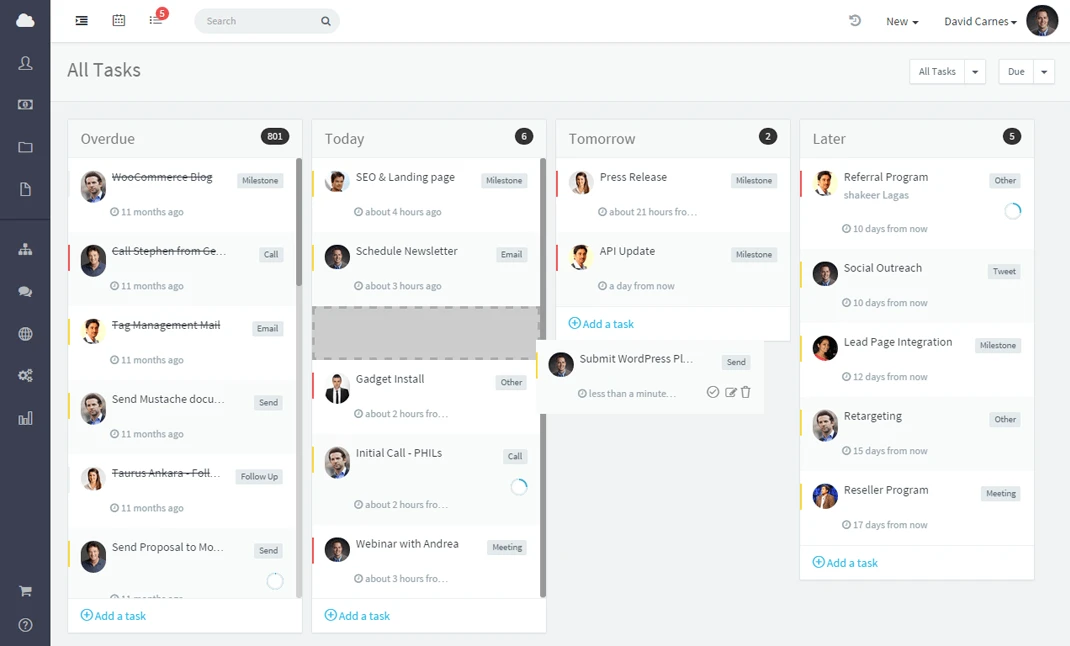
monday CRM suits small teams seeking visual sales pipelines with automated project delivery, while Insightly is best for businesses that need to convert won deals directly into post-sale customer projects. ClickUp serves teams requiring flexible multi-view task execution and custom fields with built-in CRM templates. These seven platforms balance native customer pipeline tracking, task and deliverable coordination, entry-level pricing commitments, and onboarding ease for non-technical teams.
monday CRM for visual sales pipelines and project delivery
These software options were evaluated and selected based on their balance of native CRM pipelines versus task tracking features, per-user pricing and minimum seat requirements, and ease of adoption for non-technical teams. monday CRM is ideal for individuals and small teams adopting CRM who need an intuitive work OS that merges sales deals with light project delivery.
Its primary workflow strength centers on visual Kanban pipelines with customizable deal stages, lead-to-close tracking, and instant deal-to-project conversion. When an opportunity closes, users can shift deal data directly into delivery boards without rebuilding project records.
Pricing starts at $12 per seat per month billed annually (prices checked in November 2026). Paid tiers require a minimum of three seats, creating a true starting cost of $36 per month (3 × $12 = $36).
The main drawback is this mandatory three-user minimum commitment for solo operators or pairs. Teams also face friction when attempting granular tracking of time and costs against individual tasks.
Insightly for deal-to-project conversion
Insightly’s Plus plan helps small teams simplify customer workflows, stay organized, and move quickly between sales and delivery. It keeps customer account records and delivery milestones in one shared space.
Its standout workflow capability is automated deal-to-project conversion, transforming won sales deals directly into tracked projects within the same workspace to align account executives and project teams without handoff gaps. Teams can convert closed opportunities into active milestones with assigned owners immediately.
Workflow automation is supported by AppConnect middleware, enabling no-code app-triggered automations across more than 500 integrations. This lets operations staff connect external tools without writing custom code.
The Plus plan starts at $29 per user per month billed annually. The free plan is capped at a strict two-user limit.
A comparatively high entry price for paid tiers ($29 per user per month) and limited capacity on the two-seat free version are the main limitations.
Pipedrive for pipeline-focused teams
Pipedrive’s Lite tier is designed for new teams and startups that prioritize sales pipeline velocity above complex operational coordination. The interface keeps rep attention focused on active deal stages.
A visual, Kanban-style pipeline is its primary workflow strength, where deals sit in columns by stage, storing contacts, correspondence, and upcoming activities. Sales reps can see scheduled follow-ups and update deal values directly on the board.
Post-sale task execution is handled via Pipedrive Projects, which replaces deal columns with Kanban task boards to update delivery activity. This add-on links delivery steps back to the closed sales file.
Lite begins at $24 per user monthly billed monthly, or from about $14 per user per month billed annually. Using Pipedrive Projects requires an additional $6.67 per month add-on.
The absence of automations, meeting scheduling, and two-way email client syncing, combined with the extra add-on fee required for project tracking, is the main drawback on the Lite plan.
ClickUp for customizable task and deal views
ClickUp Unlimited is best suited for small teams that require unlimited cloud storage, granular task hierarchies, and day-to-day workflow flexibility. It allows teams to structure deliverables and client accounts in nested folders.
Its core workflow strength is multi-view project management, offering List, Board, Gantt, Timeline, Workload, Calendar, and Activity views alongside specialized CRM view templates to track sales pipelines and customer records. Teams can build custom fields to monitor contract sizes, account contacts, and renewal dates alongside execution tasks.
The Unlimited plan starts at $7 per user per month with annual billing ($10 per user per month on flexible monthly billing), with the Business tier priced at $12 per user per month billed annually.
ClickUp is fundamentally a project management platform that implements CRM capabilities via templates and custom field configurations rather than through a dedicated, native sales engine, which is its main limitation.
Bitrix24 for all-in-one business operations
Bitrix24 is tailored for organizations of 5 to 50 users that need CRM pipelines, team collaboration, and task coordination consolidated within a single environment. It combines messaging, contact databases, and scheduling under one login.
Keeping all sales leads, project tasks, and internal team communication in one location, available as either cloud-hosted or on-premises software, is its primary workflow strength. Staff can discuss projects in chat, assign work tasks, and record customer details without switching applications.
Paid pricing starts on the Basic plan at $49 per organization per month billed annually ($69 billed monthly) for 5 users. The free tier is capped at a maximum of 2 users.
The primary drawback is a steep learning curve resulting from an expansive, dense feature set that can challenge non-technical team members.
Zoho CRM for synchronized sales and delivery
Zoho CRM serves sales-driven teams that require structured sales stages, lead scoring, and automated forecasting alongside client project execution. It supports companies running formal sales pipelines before passing work to delivery teams.
Native bidirectional synchronization between CRM deals and Zoho Projects is its primary workflow strength, reinforced by the Blueprint process builder and real-time SalesSignals communication alerts. Advancing a deal past negotiation can automatically populate project milestones in the connected project application.
Zoho CRM Standard starts at $14 per user per month billed annually, while the free CRM edition supports up to 3 users and 5,000 records. Adding project tracking via Zoho Projects Premium costs $5 per user per month.
Architectural fragmentation is the primary drawback, requiring users to connect and configure separate ecosystem applications to achieve end-to-end CRM and project management.
Wrike for client execution and project tracking
Wrike’s Team plan suits small, growing delivery teams where project schedules, task dependencies, and resource allocations outweigh sales pipeline tracking. It organizes operational delivery across clear milestones.
Its core workflow strength is breaking large operational goals into actionable tasks, assigning team resources, and tracking visual project schedules at a glance. Teams can link dependencies across Gantt views to prevent timeline delays.
Wrike enables in-CRM project tracking via an embedded widget that displays project progress and task completion directly on Salesforce records. Account managers can view active project status inside their CRM workspace.
The Team plan starts at $10 per user per month billed annually (supporting 2 to 15 users), with the Business tier priced at $25 per month billed annually.
Requiring a minimum of the Wrike Business plan ($25 per month) and Salesforce Enterprise or Unlimited editions for native CRM integration is the primary drawback, posing an accessibility and budget barrier for small teams.
Comparing CRM capabilities, task tracking, and pricing
Evaluating these tools requires distinguishing CRM-first platforms (monday CRM, Insightly, Pipedrive) that prioritize customer deal stages from PM-first tools (ClickUp, Wrike) focused on task execution and all-in-one suites (Bitrix24, Zoho CRM). CRM-first systems excel at pipeline progression and trigger automated client handoffs. PM-first systems come with deeper resource management, dependency tracking, and multi-view project execution, using templates or embedded widgets to handle client accounts.
Evaluating true entry costs requires calculating true minimum spend. This means contrasting per-user pricing against mandatory seat minimums such as monday CRM’s 3-seat threshold ($36 per month: 3 × $12 = $36) and Bitrix24’s 5-user organizational baseline ($49 per month). Assessing post-sale workflow execution involves identifying whether project management is built natively into core plans or requires paid add-ons. Add-ons include Pipedrive Projects ($6.67 per month, resulting in a $20.67 monthly entry spend at $14 + $6.67). They also include Zoho Projects Premium ($5 per user per month, making combined access $19 per user at $14 + $5).
Platform |
Starting Price and Billing |
Primary Workflow Strength |
Best Suited For |
Key Limitation |
|---|---|---|---|---|
monday CRM |
$12 per seat/month (billed annually, 3-seat minimum) |
Visual Kanban pipelines with instant deal-to-project conversion |
Individuals and small teams adopting CRM |
Mandatory 3-seat minimum ($36/month) and task tracking friction |
Insightly |
$29 per user/month (billed annually) |
Automated deal-to-project conversion and AppConnect middleware |
Small teams simplifying workflows between sales and delivery |
Higher entry price for paid tiers; 2-user free plan limit |
Pipedrive |
$24 per user/month (billed monthly; $14 billed annually) |
Visual sales pipelines with Kanban task boards via Projects add-on |
New teams and startups focused on sales velocity |
Requires $6.67/month Projects add-on; no automations on Lite |
ClickUp |
$7 per user/month (billed annually; $10 billed monthly) |
Multi-view project execution (List, Board, Gantt) and CRM templates |
Small teams needing flexible task hierarchies and storage |
CRM features rely on custom templates rather than a native engine |
Bitrix24 |
$49 per organization/month (billed annually, 5 users) |
Unified sales leads, project tasks, and internal communication |
Organizations of 5 to 50 users wanting one consolidated tool |
Steep learning curve due to an expansive, dense feature set |
Zoho CRM |
$14 per user/month (billed annually) |
Bidirectional sync with Zoho Projects, Blueprint builder, and SalesSignals |
Sales-driven teams needing lead scoring and automated forecasting |
Requires connecting separate ecosystem apps for full project tracking |
Wrike |
$10 per user/month (billed annually, 2–15 users) |
Task scheduling, resource assignments, and embedded CRM widgets |
Growing delivery teams focused on task execution over pipeline tracking |
CRM sync requires Wrike Business ($25/mo) and Salesforce Enterprise |
For sales-focused groups where won deals must trigger immediate project execution, monday CRM and Insightly give the most direct operational flow. Teams whose work centers primarily on project milestones, task dependencies, and resource tracking should choose ClickUp or Wrike. Organizations seeking to consolidate internal chat, client files, and deal pipelines into a single tool will find Bitrix24 or the Zoho ecosystem the most practical choice.