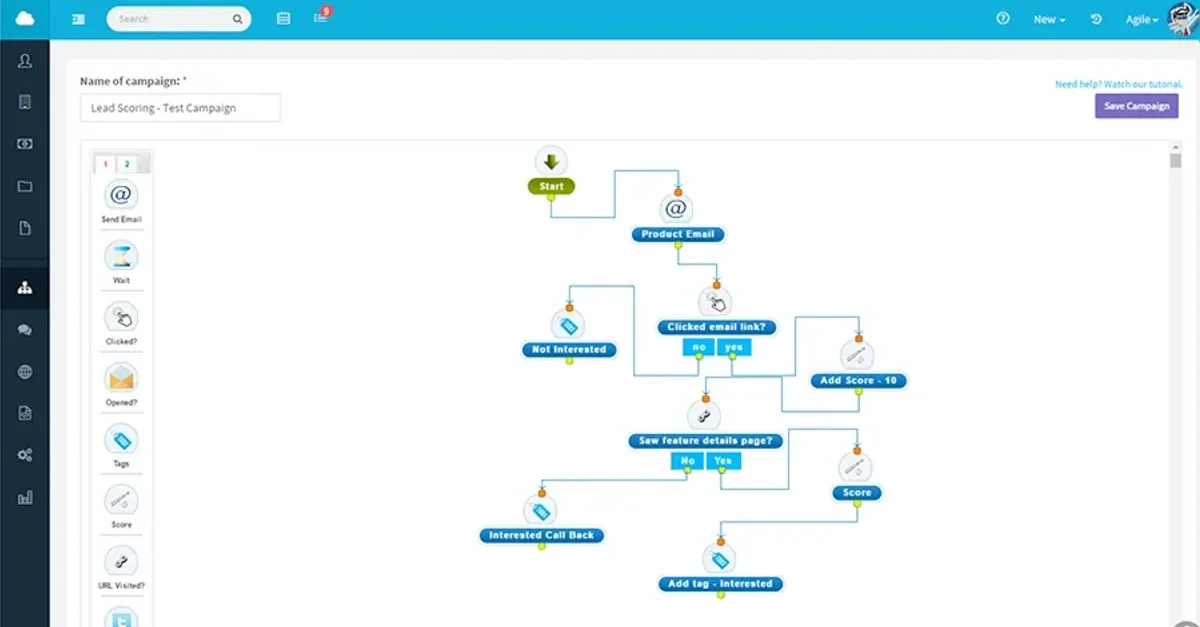
Modern CRM marketing automation startups are shifting away from static contact databases toward autonomous systems that coordinate the entire Go-To-Market lifecycle. While 65 percent of sales professionals actively rely on CRM software, early-stage companies increasingly bypass legacy enterprise platforms burdened with four-figure onboarding fees in favor of lean, AI-native platforms that combine sales sequences, real-time customer signals, and marketing automation without creating technical debt.
How Startup CRMs Evolved from Static Databases to GTM Engines
Startup CRM marketing automation platforms unify contact records, automated messaging, and pipeline intelligence into a single operational system. Unlike legacy CRMs retrofitted from email tools, modern platforms autonomously capture interaction timelines, trigger behavior-driven outreach, and sync communications across sales and support channels to accelerate revenue without manual data logging.
Data published by Act.com reveals that 97 percent of sales professionals view sales technology, including CRMs, as important or very important to their daily operational performance. This reliance stems from a structural shift in how young companies generate pipeline. Early sales environments historically relied on manual data entry, requiring representatives to log call notes, copy email threads, and update opportunity stages by hand. This administrative burden consistently resulted in outdated records, missing prospect context, and interrupted buyer journeys.
Modern platforms address this friction by converting the central database into an active execution engine. Instead of functioning as passive storage, the software records touchpoints autonomously across inboxes, calendar events, and live conversations. Automating these administrative workflows relieves startup teams from repetitive tasks, allowing founders and account executives to dedicate their time to strategic execution, customer engagement, and market positioning.
This operational transition is defined by three fundamental functional shifts:
- Autonomous interaction capture: Background synchronization continuously logs email threads, calendar invites, and customer messages into a unified chronological feed without manual rep data entry.
- Behavior-driven workflow triggers: Contact status updates, product usage thresholds, and website visits automatically initiate context-specific outreach sequences rather than static calendar drips.
- Cross-functional pipeline synchronization: Inbound marketing qualified leads, sales pipeline stages, and customer success conversations share a single record structure, preventing communication blind spots.
By coordinating customer interactions automatically, modern startup platforms eliminate the data hygiene decay that typically undermines early sales operations.
All-in-One Suites vs Modular Stacks: The Architectural Trade-Off
Founders selecting a Go-To-Market infrastructure face a fundamental architectural choice: adopt a unified all-in-one suite or assemble specialized best-of-breed point solutions. While consolidating operations into a single platform offers administrative simplicity, it introduces systemic structural vulnerabilities.
Centralizing all commercial operations inside one platform creates a single point of failure across the business. As an operations analysis by Gegidze Ops Update published on LinkedIn observed:
When your CRM becomes the linchpin of your entire tech stack, it’s like building a Jenga tower on a single block—it’s only a matter of time before it all comes tumbling down.
When an all-in-one suite experiences service disruption, customer support ticketing, automated billing notifications, sales sequence delivery, and meeting scheduling collapse at the exact same moment. Beyond operational fragility, all-in-one platforms frequently lock customer data inside proprietary database structures. This isolation prevents technical teams from querying raw event logs and complicates product analytics, isolating engineering and commercial teams into separate operational realities.
Conversely, assembling a modular stack of specialized tools introduces substantial integration overhead. Connecting independent engines for email delivery, pipeline tracking, support ticketing, and lead enrichment requires persistent API maintenance and webhook monitoring. An operational case study shared on LinkedIn highlighted an organization that required four internal staff members dedicated strictly to maintaining an all-in-one ClickUp platform and its associated operational connections. Furthermore, industry surveys show that best-of-breed multi-tool environments frequently record lower user satisfaction regarding software integration due to synchronization lag, credential management friction, and broken field mappings.
Platform analysts at Lindy.ai noted that all-in-one systems like EngageBay trade custom technical depth for operational simplicity. For small teams operating with limited administrative bandwidth, that trade-off often represents the only practical path to deployment.
Architectural Warning: Concentrating customer data, pipeline workflows, and messaging automations into a single monolithic vendor creates an acute operational vulnerability during outages. Conversely, adopting uncoordinated point solutions without dedicated internal technical bandwidth risks data fragmentation and high maintenance overhead.
Emerging Startup CRMs and Their Ideal Use Cases
The software landscape for early-stage Go-To-Market execution has diversified beyond legacy enterprise providers. Emerging platforms now specialize in distinct operational motions, aligning with specific business models, support channels, and deal velocities.
All-in-One Growth Suites: EngageBay and ActiveCampaign
All-in-one platforms prioritize functional breadth over specialized depth, combining sales pipelines, email sequences, marketing landing pages, and basic ticketing within a single administrative console. EngageBay provides a comprehensive entry point for cash-conscious teams, offering a free tier supporting up to 250 contacts and paid plans starting at $14.99 per user per month. This pricing model allows pre-seed startups to automate basic contact routing and email nurture sequences without incurring multi-thousand-dollar annual commitments. In contrast, ActiveCampaign, which was founded in 2003 as an email marketing service before adding a dedicated sales CRM in 2014, specializes in complex event-driven automation rules. Because ActiveCampaign retrofitted its sales pipeline on top of an autoresponder foundation, it excels at behavior-based lead nurture campaigns but offers less native depth for complex B2B sales cycles.
B2B Sales and Pipeline Automation: Salesflare and Attio
Startups executing direct B2B sales require relationship-first architectures rather than mass email broadcast tools. Salesflare automates contact relationship management by connecting directly to company email and calendar accounts, autonomously assembling prospect profiles, interaction histories, and follow-up timelines without manual input. This automated logging eliminates the data decay typical of early-stage spreadsheets. For technical teams requiring modern, flexible data modeling, Attio provides an AI-native CRM platform that functions as a real-time relational database, allowing operators to construct custom sales workflows, enrich inbound signups, and link customer data to external data warehouses. For e-commerce businesses, platforms like Drip address transaction-based lifecycles, using behavior-driven customer journeys to curb cart abandonment and drive repeat transactions.
Conversational and Native Support Hubs: Pylon and Intercom
For B2B software companies managing customer relationships directly inside collaborative chat environments, conversational support hubs have emerged as core operational platforms. Pylon, founded in 2022 in San Francisco by Advith Chelikani, Marty Kausas, and Robert Eng, raised $51.3 million in funding to build a B2B support platform operating natively within Slack and Jira. Pylon allows customer success and sales teams to convert chat threads into tracked tickets and pipeline signals without forcing buyers into external portals. Intercom, founded in 2011 in San Francisco by Ciaran Lee, David Barrett, Des Traynor, and Eoghan McCabe, has raised $240.8 million to integrate AI customer service chatbots with a shared team inbox and automated engagement workflows.
At the enterprise prediction tier, platforms like Optimove, founded in 2009 in Tel Aviv by Pini Yakuel and Shachar Cohen with $95 million in funding, utilize a customer data platform to drive autonomous journey personalization across large consumer audiences. Similarly, CRED, founded in 2023 in London by Anthony Meir, Chaitanya Shah, and Jon Carr-Harris with $15 million in funding, operates as an intelligent business hub integrating predictive intelligence and real-world signals into daily operations.
The following comparison matrix outlines how leading platforms compare across architectural priorities, pricing structures, and ideal startup operating models.
Platform |
Primary Focus |
Starting Price / Structure |
Key Advantage |
Best Fit |
|---|---|---|---|---|
EngageBay |
All-in-one sales, marketing, and support |
Free for 250 contacts; paid from $14.99/user/month |
Zero integration overhead across basic GTM functions |
Pre-seed teams needing simple shared tools |
Salesflare |
B2B pipeline and contact timeline automation |
Tiered per-seat monthly billing |
Autonomous email and calendar timeline logging |
B2B sales teams running relationship-driven sales |
Optimove |
Autonomous journey personalization |
Custom enterprise SaaS pricing |
Customer data platform with predictive intelligence |
High-volume consumer brands scaling retargeting |
Pylon |
Collaborative B2B support and retention |
Tiered business plans |
Native two-way synchronization with Slack and Jira |
B2B SaaS companies running shared Slack channels |
HubSpot |
Inbound marketing, pipeline, and operations |
Free CRM; Sales Hub Pro at $90-$100/seat/month |
Expansive ecosystem and unified contact timeline |
Funded scaleups requiring standardized GTM processes |
Reviewing these functional differences helps founders select a platform that supports their specific sales motion without overpaying for enterprise infrastructure.
Evaluating Total Cost of Ownership and Pricing Traps
Startups evaluate CRM pricing by balancing initial entry tiers against mandatory onboarding fees and contact scaling penalties. While free tiers like HubSpot accommodate up to one million contacts, unlocking automated sequences requires paid tiers costing $90 to $100 per seat monthly plus a mandatory $1,500 onboarding fee, making lightweight alternatives more cost-effective.
Evaluating software expenditures based solely on entry-level advertised prices leads to severe budget miscalculations. Entry-level tiers frequently restrict automated triggers, webhook access, and sequence capacity, forcing teams to upgrade to mid-tier plans far sooner than planned. Budget-focused tools provide transparent entry points: Moosend offers entry email automation workflows starting at $9 per month, GetResponse connects webinar-driven conversion funnels starting at $19 per month, and EngageBay provides a full marketing and sales suite starting at $14.99 per user per month. Platforms like Pipedrive provide a 14-day trial window to evaluate sales pipelines, while solutions like Salesmate maintain integration libraries exceeding 700 applications to connect peripheral software without custom code.
The financial disparity becomes visible when comparing lightweight options against legacy platforms. HubSpot allows startups to store up to one million companies and contacts on its free plan, creating an appealing zero-cost starting environment. However, when a sales team requires automated outreach sequences, custom deal routing, and pipeline automation, they must upgrade to HubSpot Sales Hub Professional. This tier costs $90 per seat per month on annual contracts or $100 per seat per month on monthly terms, accompanied by a mandatory $1,500 onboarding fee. For a three-person sales team, first-year cash commitments jump from zero to nearly $5,000 immediately.
The table below summarizes entry costs, scaling thresholds, and mandatory onboarding fees across popular platforms.
Platform |
Base Price |
Contact Limits / Scaling |
Mandatory Fees |
Evaluation Period |
|---|---|---|---|---|
EngageBay |
$14.99 / user / month |
250 contacts on free tier |
None |
Free plan available |
HubSpot Sales Hub Pro |
$90 – $100 / seat / month |
1 million contacts (free tier) |
$1,500 onboarding fee |
Free basic CRM tier |
Moosend |
$9 / month |
Scales by subscriber count |
None |
30-day trial period |
GetResponse |
$19 / month |
Scales by contact list size |
None |
Free trial period |
Pipedrive |
Tiered per user |
Scales by pipeline volume |
None |
14-day free trial |
Understanding these mandatory fees and scaling thresholds prevents early-stage teams from exhausting capital on software overhead before establishing predictable revenue.
How Startups Should Choose Their Automation Stack
Selecting an automation platform requires balancing functional requirements against internal technical resources. Automating unproven or broken sales processes accelerates confusion rather than revenue. As automation consultant Tommaso Maria Ricci explained regarding operational systems:
None of these risks make automation a bad idea. They make unplanned automation a bad idea. Build governance structures proportionate to the risk level of each workflow.
When deployed systematically, automated workflows generate measurable financial returns. Commercial case studies document that organizations implementing structured AI workflow automations achieved a 30 percent increase in sales revenue over six months. Achieving similar outcomes requires evaluating software through a structured four-stage selection sequence:
- Audit the conversion model: Determine whether commercial growth depends on direct outbound B2B sales conversations, automated product-led signups, or transactional e-commerce checkouts. Choose platforms built specifically for that motion.
- Assess internal maintenance bandwidth: Calculate the engineering hours available to maintain API connections and webhook syncs. If dedicated technical resources are absent, choose an all-in-one suite to avoid hiring operational staff solely to manage integrations.
- Verify architectural lineage: Confirm whether the software was engineered as a CRM-first platform or retrofitted from an email autoresponder. Tools designed around sales pipelines manage complex deal velocity and rep follow-ups far more effectively than email marketing platforms with added CRM tabs.
- Establish progressive workflow governance: Implement automated routines gradually. Configure automated contact timeline capture and basic lead scoring rules before activating dynamic multi-channel outreach campaigns and automated deal reassignment.
Following this structured sequence protects startups from common operational traps. As noted by analysts at the Salesflare Blog, following a disciplined three-to-four-step evaluation framework positions a founding team ahead of 99 percent of competing startups, which routinely skip systematic technical evaluation and encounter operational failure.
FAQ
Can startups start with a free CRM before paying for marketing automation?
Yes. Platforms like HubSpot offer free CRM tiers supporting up to one million contacts, while EngageBay provides free access for up to 250 contacts. However, automated marketing sequences and advanced workflows typically require upgrading to paid plans starting between $14.99 and $100 per month.
Why do some startups avoid all-in-one CRM platforms?
All-in-one platforms risk creating a single point of failure across billing, scheduling, and support, while functioning like a Jenga tower where data becomes trapped in proprietary silos. Maintaining an all-in-one system can also demand significant internal overhead, sometimes requiring multiple full-time staff to manage configurations.
What is the difference between a CRM-first and marketing-first platform?
CRM-first platforms like Salesflare are built around sales pipeline interactions and automated relationship tracking. In contrast, marketing-first platforms like ActiveCampaign originated as email autoresponders and later retrofitted sales CRM capabilities, which can result in weaker deal-tracking workflows for dedicated sales teams.
What revenue impact can startups expect from automating marketing workflows?
Consistent deployment of automated lead qualification, behavioral messaging, and dynamic campaigns can yield substantial growth. Documented implementations show startups achieving up to a 30 percent increase in sales revenue over six months by systematically executing automated marketing routines at scale.